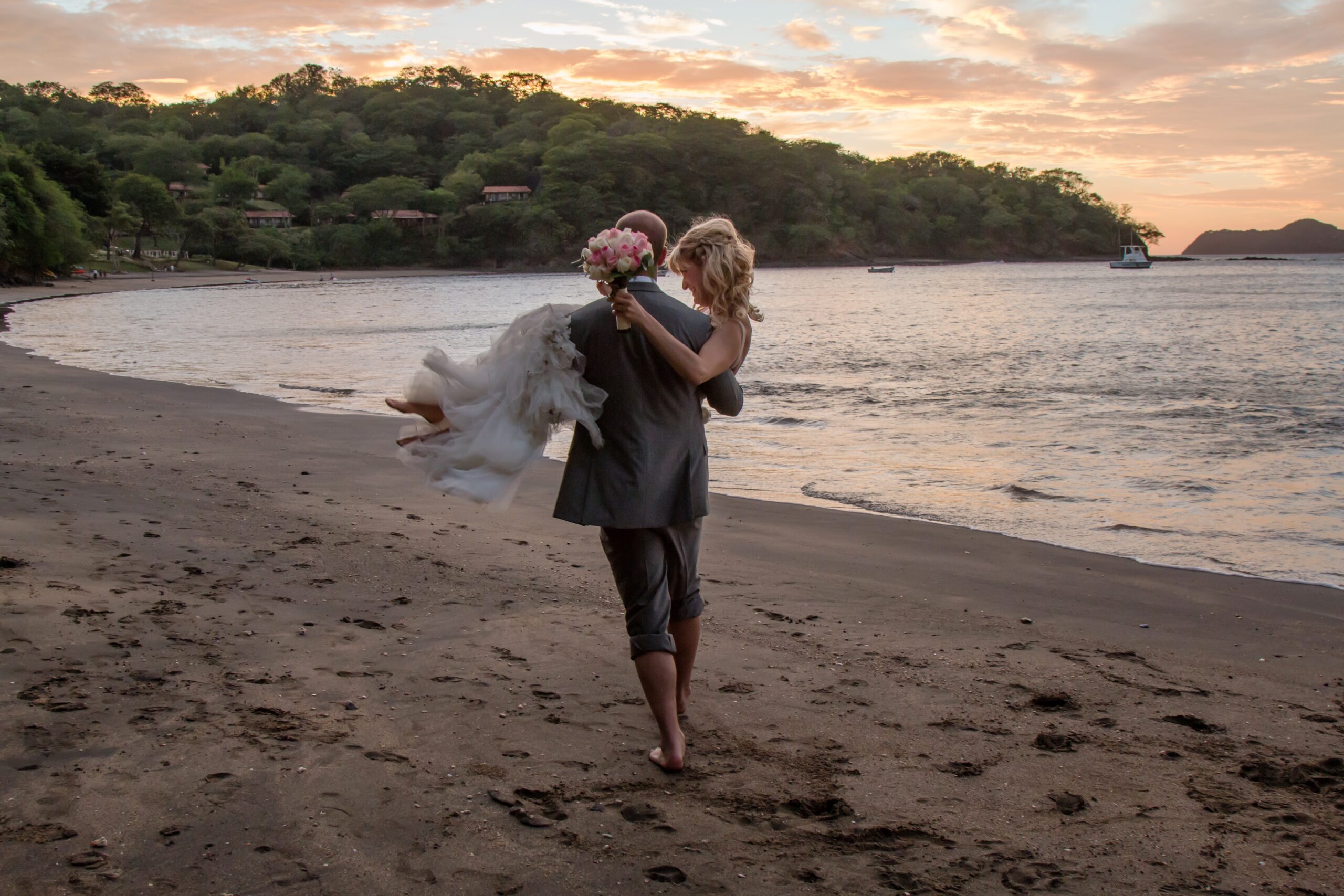

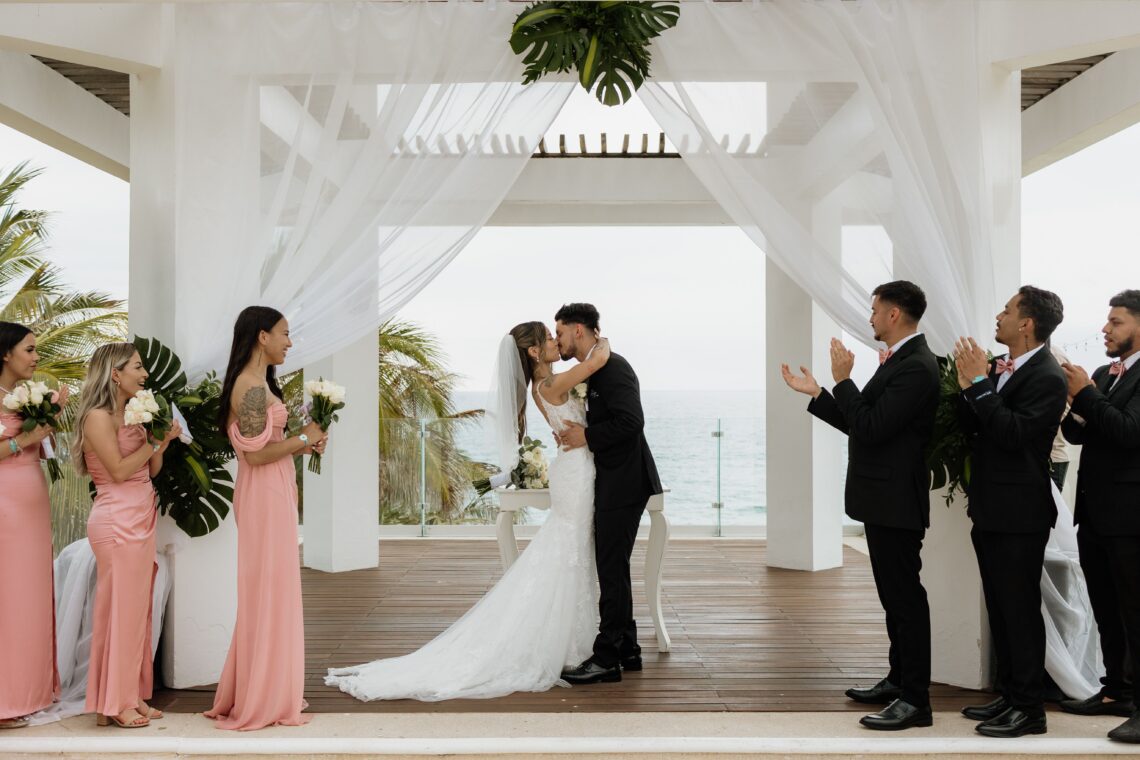
Ask a couple why they’re getting married abroad, and you’ll usually get the beach answer. It’s warm, it’s beautiful, and the photographs will be extraordinary. All true, and rarely the actual reason.
The real reasons tend to come out later in the conversation, and they’re more interesting than scenery. They’re about guest lists, family politics, time, and in a lot of cases a problem that has nothing to do with weddings at all.
Here’s what couples actually tell us, roughly in the order it comes up.
The Guest List Solves Itself
This is the one that comes up most, and rarely first, because it sounds unkind said out loud.
Every couple planning a wedding at home eventually sits down with a list of 180 names and a venue that holds 120. What follows is weeks of negotiation, with parents advocating for cousins you’ve met twice and a running tally of who’ll be offended. It’s the single most draining part of planning a wedding, and it has nothing to do with the wedding.
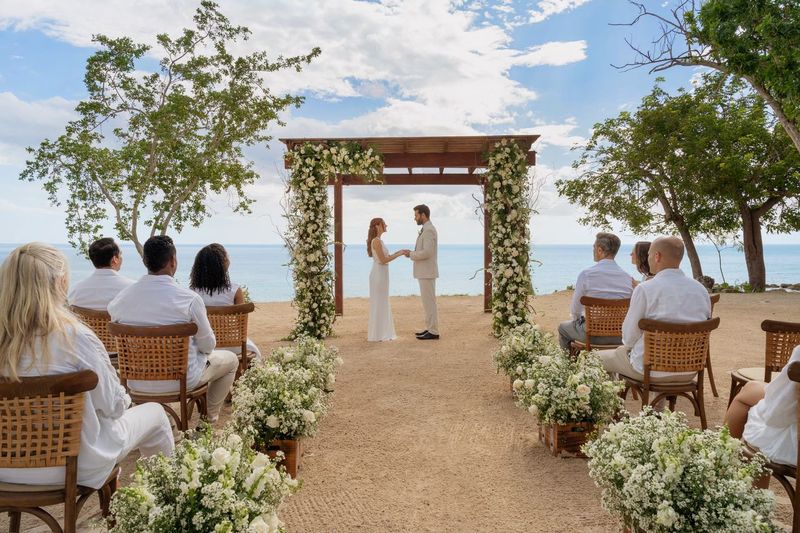
A destination wedding removes that conversation entirely. You invite everyone you’d genuinely like there, and distance does the filtering. Nobody gets cut. People choose, which is a completely different thing socially, and the ones who come are the ones who’d rearrange their year for you.
The numbers bear it out. Couples marrying with us average 38 guests in the Dominican Republic and 39 to 45 across Mexico, against the 80 to 150 typical of a wedding at home. That isn’t because couples invited fewer people. It’s because the list sorted itself without anyone having to be the villain.
You Get Days Instead of Minutes
Couples who’ve been to plenty of weddings often describe the same realization: the people getting married barely spoke to anyone. One long, tightly scheduled day, a receiving line, a few rushed minutes per guest, and then it’s over.
A destination wedding runs four or five nights. You have breakfast with people. You sit by a pool with your college roommate for two hours on the Tuesday. Your parents meet your partner’s friends properly rather than in a photograph. The ceremony is the centerpiece, but it isn’t the whole of it.
When we ask guests afterward what made a wedding memorable, the answer isn’t the venue or the food. It’s having real time with the couple. That’s the strongest argument for this format, and the one couples most consistently say they underestimated beforehand.
It Costs the Couple About a Third as Much
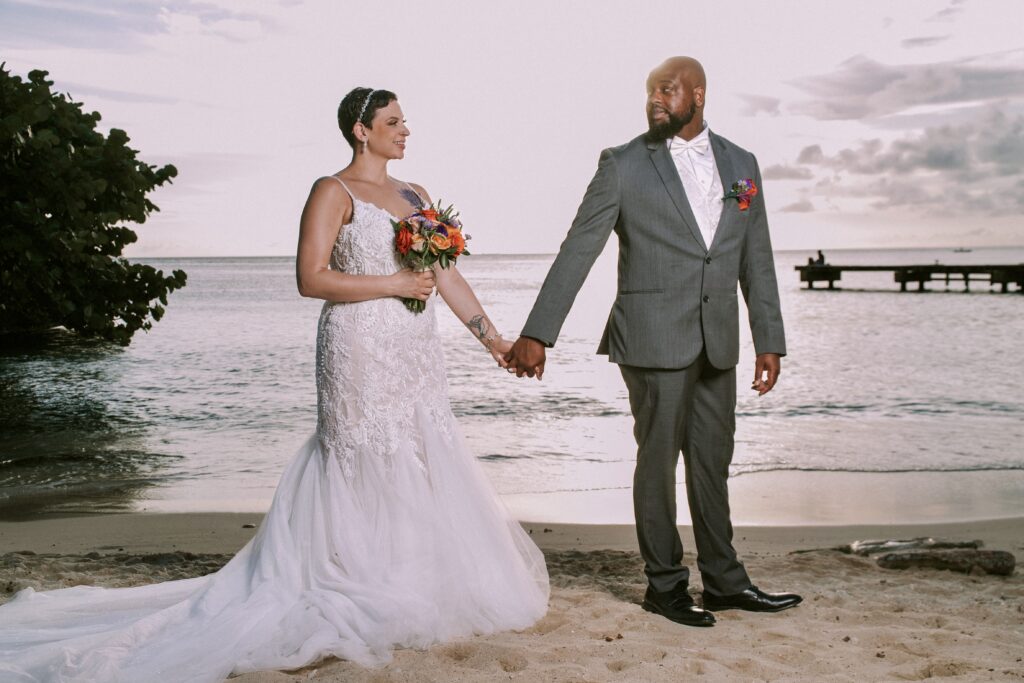
The average wedding in the United States now runs around $36,000. Couples who book a destination wedding with us average $8,959 in the Dominican Republic, $10,218 in Mexico, $10,440 in Jamaica, and $10,705 across the wider Caribbean, covering the wedding package, their own accommodations, airfare, and extras.
These averages reflect real spend data from couples who booked with our Certified Destination Wedding Specialists, and cover the couple’s own costs rather than the whole group’s.
That last point deserves saying plainly rather than buried. The reason the couple’s number is lower is that guests book and pay for their own flights and rooms, exactly as they would for any wedding they had to travel to. The total spend across everyone involved is closer than the headline figures suggest. Some couples find that uncomfortable and some find it straightforwardly fair, and it’s worth deciding which camp you’re in early.
One Coordinator Instead of Twelve Vendors
This one is badly underrated, and for a lot of couples it matters more than the money.
A wedding at home means separate contracts with a venue, a caterer, a bar service, a rental company, a florist, a baker, a DJ, a photographer, and whoever is setting up the chairs. Nine relationships to manage, nine invoices, nine people who need to be told the same thing, and every one of them is your problem if they don’t turn up.

At an all-inclusive resort, most of that is one package and one on-site coordinator who does this every week. The venue, the setup, the catering, the bar, the cake, and the officiant arrive together. You have far fewer decisions to make, and the ones you do make are about what you want rather than who to chase.
Couples with demanding jobs, or who are planning from a different city than where they’d marry, often choose a destination wedding for this reason alone.
The Number Is Predictable
Related, but distinct. A hometown wedding budget is a collection of separate line items that each creep a little, and the final number is genuinely hard to know until it’s spent.
A package at an all-inclusive gives you a figure up front that covers the ceremony, the reception, the food, and the drinks. There are still extras, and we’d never pretend otherwise, but the shape of the total is visible from the start. For couples paying for this themselves, that predictability is often worth more than the saving.
The Honeymoon Has Already Started
A smaller point, but a real one. You’re already somewhere warm with nothing scheduled. Plenty of couples simply stay on after everyone flies home, sometimes moving to a quieter property for a few nights.
That saves a second set of flights, a second block of annual leave, and the oddly deflating experience of going back to work three days after your wedding.

And the Reason Nobody Writes About: Nowhere Is Home
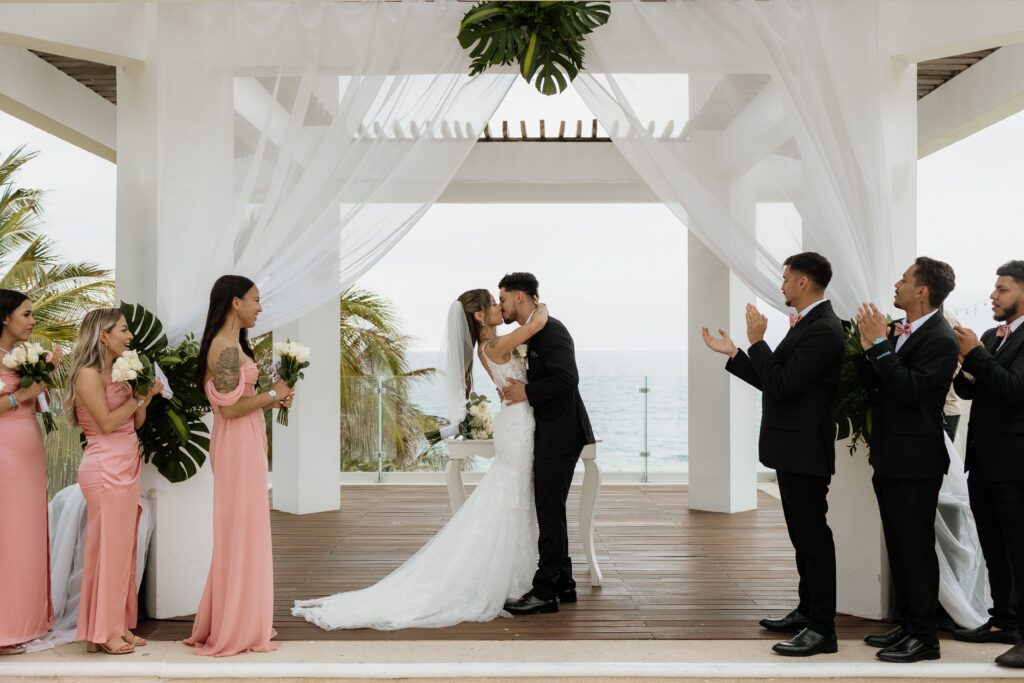
This comes up far more than anyone acknowledges, and for a certain kind of couple it’s the whole answer.
A hometown wedding assumes there’s a hometown. For plenty of couples, there isn’t one anymore. You grew up in one state, went to college in another, live in a third, and your partner’s family is spread across two more. Your friends are scattered across the country. There is no place where holding the wedding means most people can drive.
Once everyone has to fly regardless, the logic shifts completely. If your guests are buying plane tickets either way, the question stops being “where is convenient” and becomes “where would we all actually want to be.” A resort in Mexico and your partner’s parents’ town might cost a guest in Chicago roughly the same. One of them has a beach.
There’s a second version of this that’s more delicate. When families are blended, when parents are divorced and remarried, or when two families have very different expectations of what a wedding should be, a hometown venue is rarely neutral. Somebody’s church, somebody’s country club, somebody’s side of town. Choosing somewhere that belongs to nobody defuses a problem that has nothing to do with weddings and everything to do with families, and it does it without a single difficult conversation.
Couples rarely lead with this. It tends to arrive about twenty minutes into a call, usually prefaced with “it’s complicated.”
Who a Destination Wedding Doesn’t Suit
It isn’t the right answer for everyone, and we talk couples out of it regularly.
If you have a large local family and a community you’re genuinely embedded in, the guest list filtering that helps other couples is simply a loss. Forty people you’d actively miss is a different situation from eight.
If your ceremony is tied to a particular church, temple, or tradition in a particular place, that usually wins, and it should.
And there’s a distinction worth being precise about, because these two feelings are easy to confuse from the inside. If what’s making you dread your wedding is the cost and the scale, a destination wedding solves it. If what’s making you dread it is being looked at, being the center of attention, the performance of the whole thing, then a destination wedding doesn’t solve that at all. It gives you a smaller audience for longer. Couples in that position are often happier eloping, and we’ve written a fuller comparison in our guide to choosing between a wedding, an elopement and a destination wedding.

Why Have a Destination Wedding FAQs
What are the main benefits of a destination wedding?
A smaller guest list that sorts itself out without difficult conversations, several days with your people instead of a few rushed minutes each, a cost to the couple around a third of a wedding at home, and far less planning because a resort package bundles the venue, catering, bar, and coordination into one contract.
Are destination weddings cheaper for the couple?
Usually yes, and substantially. Couples booking with us average between about $9,000 and $11,000 depending on the destination, against roughly $36,000 for the average wedding in the United States. The difference is that guests pay for their own flights and rooms, so the total across everyone is closer than those two numbers imply.
How many guests come to a destination wedding?
Most couples see between 20 and 45 guests, depending on the wedding destination and how easy it is to reach. Our couples average 38 in the Dominican Republic and 39 to 45 across Mexican destinations. Flight cost and flight time predict attendance more reliably than anything else you control.
Is it rude to ask guests to travel for your wedding?
No, as long as you give plenty of notice and make it easy to decline. Twelve months, a clear book-by date, a realistic range of room prices, and no pressure on anyone who says no. Many guests treat it as a holiday they’d have taken anyway, and the ones who can’t come generally appreciate having been asked.
What is the biggest downside of a destination wedding?
Some people genuinely can’t come, and not always for reasons they’ll tell you. Cost, annual leave, health, and childcare all factor in. If there are forty people whose absence you’d still think about in five years, a destination wedding is the wrong format, and it’s worth being honest with yourselves about that number early.
Ready to Book Your Own Destination Wedding?
Almost nobody chooses this because of the scenery, though the scenery helps. They choose it because the guest list stops being a fight. After all, they’d rather have days than minutes, and sometimes because there’s no longer anywhere that counts as home for everyone involved.
If any of that sounds like your situation, fill out our online wedding planning form and one of our Certified Destination Wedding Specialists will tell you honestly what it would cost and how many of your people would realistically make the trip!

About the Author

Maggie Sabin
Maggie started as the SEO Manager at DestinationWeddings.com in 2024, where she works to drive organic traffic and conversions while creating meaningful, SEO-optimized content for the website. Previously, Maggie's career spanned from Human Resources & Recruitment to teaching at international schools for almost 10 years. Maggie spends her free time traveling, learning new languages, reading non-fiction books, working out, going to the beach and spending time cuddling her dog, Lola!