
A Caribbean destination wedding sounds simple from the outside (pick an island, get on a plane, say your vows on a beach), and once you’ve picked the island, it largely is. That first decision is the hard part. The Caribbean isn’t one destination; it’s more than 7,000 islands stretching from the Bahamas down to Aruba off the Venezuelan coast, and they differ from each other on everything that matters to a destination wedding: legal requirements, cost, flight access, weather patterns, and character.
This guide is built for the stage before you’ve committed to a specific island. It walks you through choosing between them, then through every step that follows, in order, so you know exactly what’s coming and when. Our Certified Destination Wedding Specialist can help you decide which one fits your timeline and priorities.
The Caribbean Wedding Process at a Glance
Most Caribbean weddings follow the same path. The total planning timeline runs roughly 12 to 18 months from “we’re getting married in the Caribbean” to the wedding day itself. Here’s the broad shape:
- Months 12 to 18 out: Set a budget, choose your island, decide on a legal or symbolic ceremony, pick a date, connect with a Certified Destination Wedding Specialist, choose your resort.
- Months 6 to 12 out: Lock in your room block, customize your package, send save-the-dates, start gathering legal documents.
- Months 2 to 6 out: Send formal invitations, finalize vendors, plan group activities, and confirm details with your on-site coordinator.
- Wedding week: Arrive within your island’s required window, complete any final paperwork, host welcome events, and exchange vows.
- After the wedding: Collect your marriage certificate and register it at home.
For the destination-feel breakdown of the region, see our Caribbean travel guide. This piece focuses on the how.
The Full Step-by-Step Caribbean Wedding Planning Process
Phase 1: Decisions Before You Book
Step 1: Choose Your Island
Everything else follows from this. Islands vary enormously in what they’ll ask of you legally and what they’ll cost, so it’s worth comparing before you fall for a photograph. Here’s how the most popular wedding islands stack up, using our own couple spend data for the cost figures:
| Island | Time on island before the ceremony | Average total | Known for |
|---|---|---|---|
| Dominican Republic | 3 business days | $8,959 | Best value, deepest resort inventory in the region |
| Jamaica | 24 hours | $10,440 | Simplest legal process, food and music culture |
| Antigua | No waiting period | $10,080 | 365 beaches, small boutique properties |
| St. Lucia | A few days, or none with a special license | $10,843 | The Pitons, rainforest and mountain scenery |
| Aruba | Documents filed roughly 2 months ahead | $11,812 | Outside the hurricane belt, year-round weather |
| Barbados | No waiting period | $14,700 | British-Caribbean culture, upscale properties |
Legal requirements change and vary in detail, so treat this as a starting comparison rather than the final word, and confirm the current process with the consulate or embassy of your chosen island before you commit.
Our guide to legally getting married in the Caribbean goes island by island in more depth. If none of the mainstream options feel right, our roundup of off-the-beaten-path Caribbean wedding spots covers the quieter alternatives.
Step 2: Choose Between a Legal and a Symbolic Ceremony
Once you’ve narrowed the island, this decision gets easier, because the answer often depends on what that island asks of you. Where the legal process is light, like Jamaica or Antigua, most couples marry legally on the island. Where it’s heavier, like Aruba’s advance filing or the Dominican Republic’s apostille and translation requirements, more couples handle the paperwork at home and hold a symbolic ceremony.
A symbolic ceremony carries no legal weight and has no document requirements, which frees you to marry anywhere and write the ceremony however you like. Same-sex couples should note that legal recognition varies widely across the region, so raise this early with your Certified Destination Wedding Specialist.
Step 3: Set Your Budget
Across the Caribbean as a whole, our couples spend an average of $10,705 all-in, covering the wedding package, accommodations, airfare, and add-ons, with the realistic range running from roughly $5,000 at the intimate end to $17,000 and beyond for larger celebrations. Hotel costs average about $415 per person per night across the region, and airfare runs $300 to $800 per person depending on your departure city and the island.
Our Caribbean couples average 10 guests, though that varies sharply by island: the Dominican Republic and Jamaica see much larger groups, while Aruba and the smaller eastern islands skew toward elopements. The couple traditionally covers their own travel and the wedding costs, while guests cover their own airfare and rooms.
Step 4: Pick Your Wedding Date
December through April is the dry season across nearly the whole region, and it’s peak wedding season for good reason: reliable sun, lower humidity, and steady trade winds. Hurricane season officially runs June through November, with September and October carrying the highest risk.
The important exception is the far southern Caribbean, where Aruba, Curacao, and Bonaire sit below the usual storm track and stay dependable year-round. May and November are the shoulder months worth targeting across the region for the balance of decent weather and softer rates.
Our guide to the best time to get married in the Caribbean breaks this down island by island.
Phase 2: Booking and Planning
Step 5: Connect with a Certified Destination Wedding Specialist
Working with a Certified Destination Wedding Specialist is free for the couple, since they are paid by the resort partners. At the regional level, the most valuable thing a DW Specialist does is help you shortlist islands against your actual constraints: where your guests are flying from, what your budget really supports, whether you need a legally binding ceremony, and how many people you’re bringing. That’s a genuinely hard comparison to run yourself across a region this varied. Plan for 12 to 18 months of lead time for peak-season dates.
Step 6: Choose Your Resort and Ceremony Venue
Match your resort to your guest count, your budget, and the atmosphere you want. Nearly every Caribbean all-inclusive offers multiple ceremony settings, usually a beachfront gazebo, a garden, and a terrace, plus indoor backup. Our roundup of top Caribbean beach wedding venues is a good starting shortlist.
Popular wedding anchors across the region include:
Secrets Cap Cana Resort & Spa (Dominican Republic)
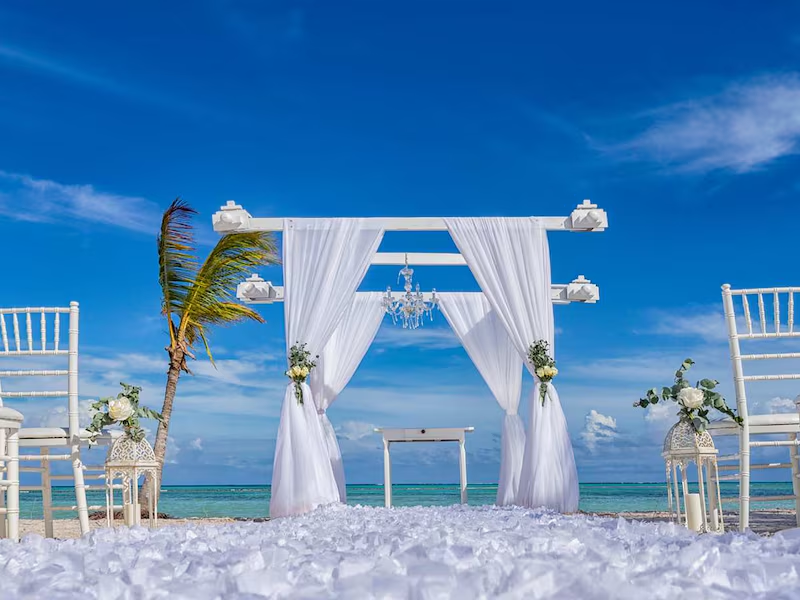
An adults-only luxury resort inside the gated Cap Cana community, with the deepest beach access in that corridor and multiple wedding package tiers. Secrets Cap Cana sits in the region’s best-value destination while still feeling genuinely refined, which is a combination the Dominican Republic does better than anywhere.
Learn more about Secrets Cap Cana Resort & Spa and get a free quote today >>
Dreams Rose Hall Resort & Spa (Jamaica)
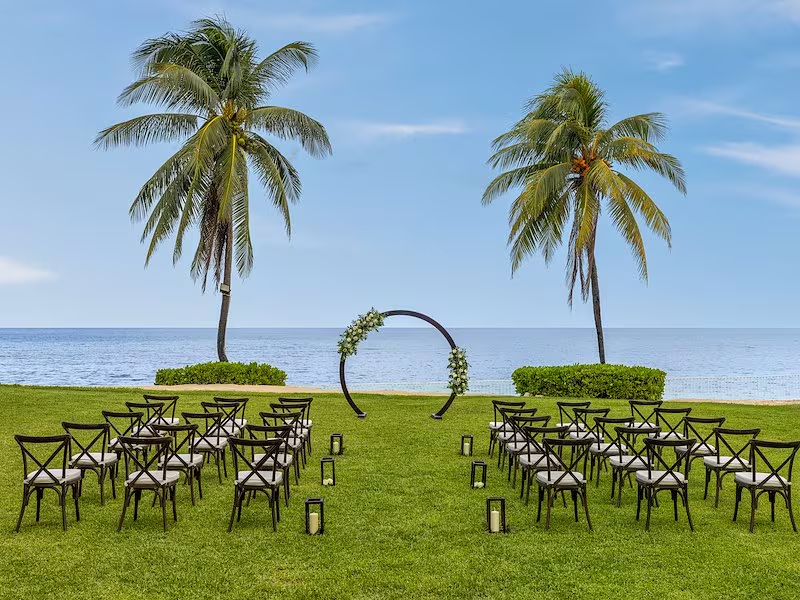
A family-friendly all-inclusive in Jamaica’s Rose Hall corridor, minutes from the Montego Bay airport with a long beach and indoor backup space. Dreams Rose Hall pairs the region’s simplest legal process with short transfers, which makes it one of the easiest Caribbean weddings to pull off with a mixed-age guest list.
Learn more about Dreams Rose Hall Resort & Spa and get a free quote today >>
Royalton CHIC Antigua
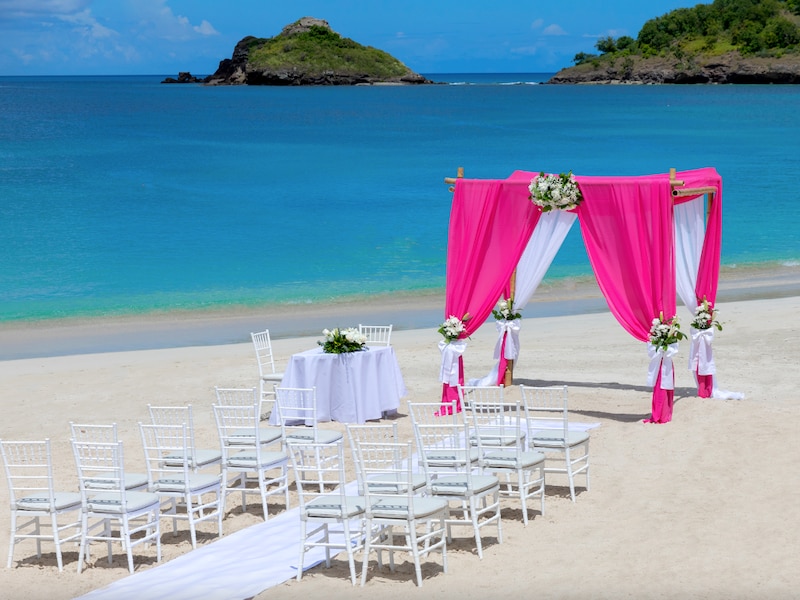
An adults-only resort on Deep Bay with a modern, design-forward feel and a livelier atmosphere than most Antiguan properties. Royalton CHIC Antigua is a strong option on an island where inventory skews small and boutique, since it can comfortably handle a larger guest list.
Learn more about Royalton CHIC Antigua and get a free quote today >>
Secrets St. Lucia Resort & Spa
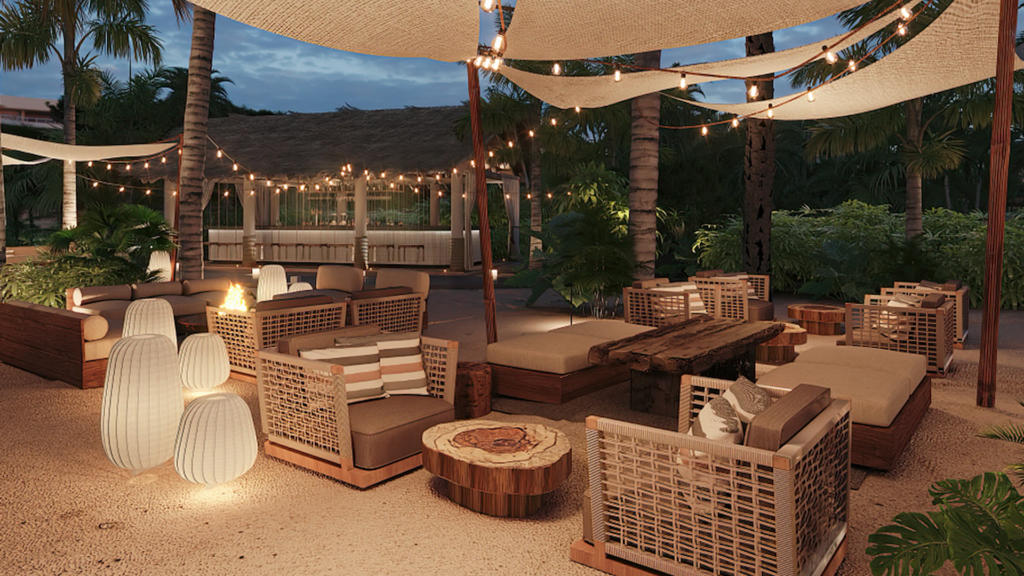
An adults-only luxury resort in northern St. Lucia with a long beach and views across Rodney Bay. Secrets St. Lucia gives you the island’s dramatic scenery with a polished all-inclusive operation, and it’s close enough to the northern towns that guests have somewhere to go.
Learn more about Secrets St. Lucia Resort & Spa and get a free quote today >>
JOIA Aruba by Iberostar
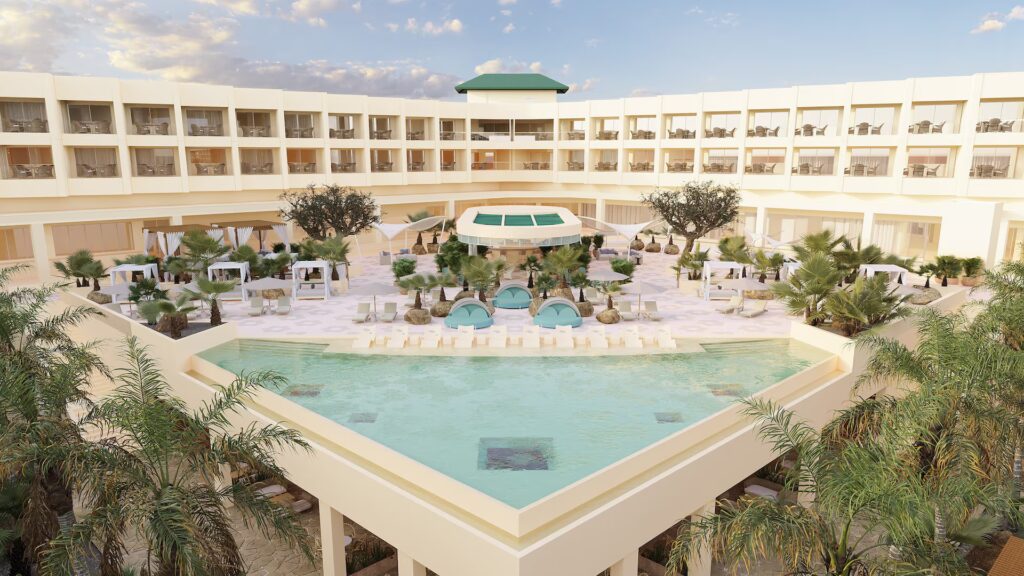
A family-friendly all-inclusive on Aruba’s Palm Beach, contemporary and wellness-focused, on the one island in the region where hurricane season isn’t part of the conversation. JOIA Aruba is the pick when a dependable forecast matters more than anything else on your list.
Learn more about JOIA Aruba by Iberostar and get a free quote today >>

Step 7: Lock In Your Room Block
A room block is a group reservation that holds rooms at a negotiated rate for your guests, and across most of the Caribbean it’s also what unlocks your wedding perks. Resorts throughout the region comp or discount the wedding package once your group books a qualifying number of rooms or room nights, with benefits scaling as the block grows: ceremony setup at the lower thresholds, then private receptions, upgraded decor, and complimentary photography hours.
Thresholds vary by island and property, so confirm the exact numbers before you count on a complimentary package. Lock the block in alongside your resort contract.
Step 8: Customize Your Wedding Package
Your on-site coordinator handles ceremony setup, florals, music, photography, dinner, and bar service. Across the Caribbean, packages start complimentary or deposit-only with a qualifying room block, then run roughly $1,100 to $2,500 at the entry tier, $3,000 to $5,500 in the middle, and $6,000 to $13,500 and up for full productions. The add-ons are where the island’s personality comes through: a steel pan band, a reggae or soca set, local rum tastings, Creole or jerk menus, and a catamaran sail for the welcome party.
One thing to ask about everywhere in the region is the outside-vendor fee, since resorts commonly charge to bring in a photographer or florist who isn’t on their approved list.
Phase 3: Pre-Travel Prep
Step 9: Gather Your Legal Documents
What you need depends entirely on the island, which is why Step 1 matters so much. Broadly, the English-speaking islands (Jamaica, Antigua, St. Lucia, Barbados, the Bahamas) ask for passports, birth certificates, and divorce or death certificates where applicable, with no translation and no apostille for English documents.
The Spanish and Dutch islands ask for more: the Dominican Republic requires apostilled birth certificates, single-status affidavits, certified Spanish translations, and consular legalization, while Aruba requires apostilled documents filed with the Civil Registry roughly two months ahead. Start whichever process applies at least 3 to 4 months before travel, because apostilles are slow.
Your resort coordinator usually handles the island-side filing. Legal requirements do change, so always confirm the current list with the consulate or embassy of your destination in your home country before you finalize anything.
Step 10: Send Invitations and Coordinate Guest Logistics
Send save-the-dates 9 to 12 months out so guests can request time off and watch airfare, then formal invitations 3 to 4 months before the wedding, with the room-block deadline clearly noted. Flight access is one of the real differentiators in this region: the Dominican Republic, Jamaica, and Aruba have deep direct service from across the US, while the smaller eastern islands often require a connection and cost more to reach.
Tell guests exactly which airport to book, note the transfer time, and mention passport validity, since most Caribbean countries want at least six months. Add group excursion ideas suited to your island.
Our RSVP and guest communication timeline maps out when to send what.
Step 11: Finalize the Details
Two to four months out, work with your coordinator to finalize ceremony scripting, florals, photography and videography, music, hair and makeup, attire, welcome bags, and the day-of timeline. The Caribbean is warm and humid nearly everywhere, and trade winds are stronger than most couples expect, so raise wind with your florist and plan attire in lighter fabrics. Confirm your officiant, your witnesses, and any cultural elements now.
Phase 4: In Destination
Step 12: Arrive and Complete Final Paperwork
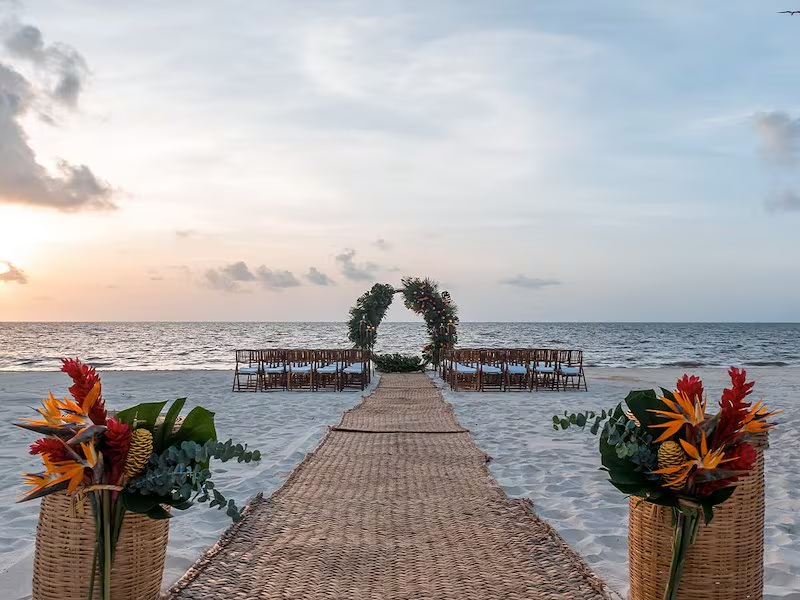
Your required arrival window depends on your island, and it ranges from nothing at all to several business days. Whatever the legal minimum, most couples arrive two to four days early to host welcome events, meet the coordinator in person, and leave a buffer for flight delays, which matter more in a region where many routes involve a connection. Your coordinator will confirm document submission and officiant availability before the day.
Step 13: The Ceremony
Your on-site coordinator runs the day-of timeline. Depending on the island, your ceremony will be performed by a marriage officer, a judge, a civil registrar, or a minister, and the number of required witnesses varies from none to four. Late afternoon is the best window almost everywhere for both comfort and light, roughly an hour before sunset. The reception follows: dinner, toasts, first dance, and dancing, usually with live local music opening the night.
Phase 5: After the Wedding
Step 14: Register Your Marriage at Home
On the English-speaking islands, this is straightforward: your certificate is issued in English, and you file a certified copy with your county clerk or vital records office at home. On the Spanish and Dutch islands, you’ll need the certificate apostilled locally before you leave, then translated into English by a certified translator once home.
Either way, keep several certified copies for name changes, taxes, and immigration paperwork, and contact your country’s embassy or consulate if you want the document authenticated before departure. Our wedding paperwork checklist covers what to hold onto.
Ceremony Options in the Caribbean
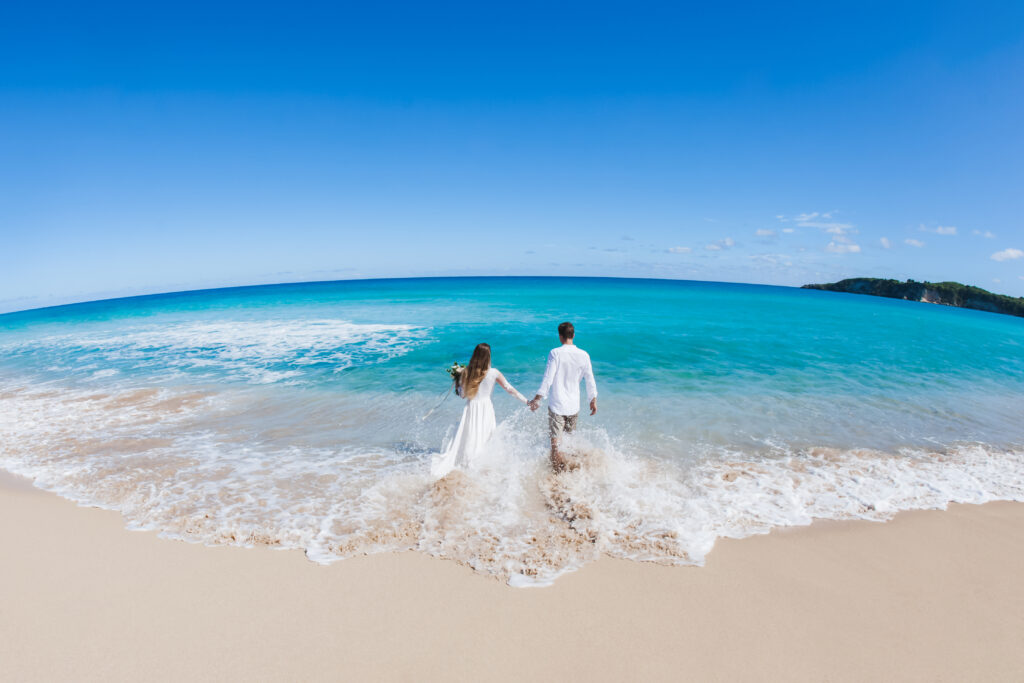
There are three ways to say “I do” in the Caribbean, and which of them can be legally binding depends on where you are.
Civil Ceremony (Legally Binding)
Every island offers a legally binding civil ceremony, but the official who performs it and the paperwork behind it differ. In Jamaica and Antigua, it’s a licensed Marriage Officer with a straightforward license. In the Dominican Republic, it’s a Notario Publico, with apostilled and translated documents. In Aruba it’s a registrar from the Civil Registry, with documents filed months in advance. Understanding which model your island uses is the single most useful thing you can learn early.
Religious Ceremony
This is where the islands differ most, and it surprises couples. On several English-speaking islands, including Jamaica, an ordained minister registered as a Marriage Officer can perform a ceremony that’s both religious and legally binding in one service.
On the Spanish-speaking islands, a religious ceremony generally isn’t legally binding on its own and needs a civil ceremony alongside it. Religious ceremonies also need longer lead times and often paperwork routed through your home parish, so raise this at the very start.
Symbolic Ceremony
A symbolic ceremony carries no legal weight, and you complete the filing at home before or after the trip. It’s the most flexible option: no documents, no arrival window, no restrictions on where you can hold it, and complete freedom over the script and the officiant. It’s the standard choice for couples marrying on islands with heavier paperwork, for anyone on a short trip, and for same-sex couples on islands that don’t perform same-sex marriages. Resorts throughout the region host symbolic ceremonies routinely.

Caribbean Wedding Planning FAQs
How long does the entire Caribbean wedding planning process take?
Plan for 12 to 18 months from the initial decision to the wedding day for peak-season dates between December and April, and 18 months or more for holiday weeks. If your island requires apostilled documents, that process alone can take 3 to 4 months, so build it into the timeline rather than treating it as a last step.
Which Caribbean island is easiest to get legally married on?
Jamaica and Antigua are the two simplest. Jamaica requires just 24 hours on the island, no blood tests, and no translations for English documents. Antigua has no residency waiting period at all, with the license typically issued the same day you apply. Both are far lighter than the Dominican Republic’s apostille and translation requirements or Aruba’s advance filing.
Which Caribbean island is the best value for a wedding?
The Dominican Republic, consistently. Our couples marrying there spend an average of $8,959 all-in, the lowest in the region, and the country has the deepest all-inclusive resort inventory in the Caribbean along with strong direct flight access. Jamaica is the next best value and adds the region’s easiest legal process.
How much should we expect to spend on a Caribbean wedding?
Our couples spend an average of $10,705 all-in across the region, covering the wedding package, accommodations, airfare, and add-ons, with a realistic range of roughly $5,000 to $17,000 and up. Hotel costs average about $415 per person per night. Where you land inside that range depends heavily on the island, since Barbados and Turks and Caicos run considerably higher than the Dominican Republic or Jamaica.
Can we get married in the Caribbean during hurricane season?
You can, and plenty of couples do for the lower rates and quieter resorts. Just understand the geography. Most of the region sits in the hurricane belt, with September and October the peak risk months, and you should carry travel insurance and have an indoor backup. Aruba, Curacao, and Bonaire in the far southern Caribbean sit below the usual storm track and stay reliable year-round, which is why they’re the go-to answer for autumn weddings.
Do all Caribbean islands recognize same-sex marriage?
No, and this varies more than almost anything else in the region. Aruba now allows same-sex marriage following a 2024 Dutch Supreme Court ruling, and several territories tied to other countries do as well. Many independent islands, including Jamaica, Antigua, St. Lucia, and the Dominican Republic, do not currently perform same-sex marriages, though resorts across the region welcome and host symbolic same-sex ceremonies. Raise this with your Certified Destination Wedding Specialist at the start so you can shortlist accordingly.
Should we choose a big island or a small one?
Larger wedding destinations like the Dominican Republic and Jamaica give you more resorts to choose from, more direct flights, better prices, and the capacity for bigger guest lists. Smaller islands like Antigua, St. Lucia, and the Grenadines give you more distinctive scenery, quieter beaches, and a more intimate feel, but they cost more, have thinner flight schedules, and their properties fill up faster. Guest count and travel budget usually settle it.
Start Planning Your Caribbean Wedding Today
The Caribbean remains the most popular destination wedding region in the world because it genuinely has a version of the celebration for everyone. Budget-conscious and big-group, luxury and intimate, legally simple and dramatically scenic, storm-season-proof and postcard-perfect. The trick is matching the island to what actually matters to you and your people, and that’s the part we do every day.
The 14-step path above is the same one our Certified Destination Wedding Specialists walk every couple through, and the heavy lifting is on us.
Fill out our online wedding planning form and we’ll match you with a DW Specialist who knows this region inside and out!

About the Author

Maggie Sabin
Maggie started as the SEO Manager at DestinationWeddings.com in 2024, where she works to drive organic traffic and conversions while creating meaningful, SEO-optimized content for the website. Previously, Maggie's career spanned from Human Resources & Recruitment to teaching at international schools for almost 10 years. Maggie spends her free time traveling, learning new languages, reading non-fiction books, working out, going to the beach and spending time cuddling her dog, Lola!