
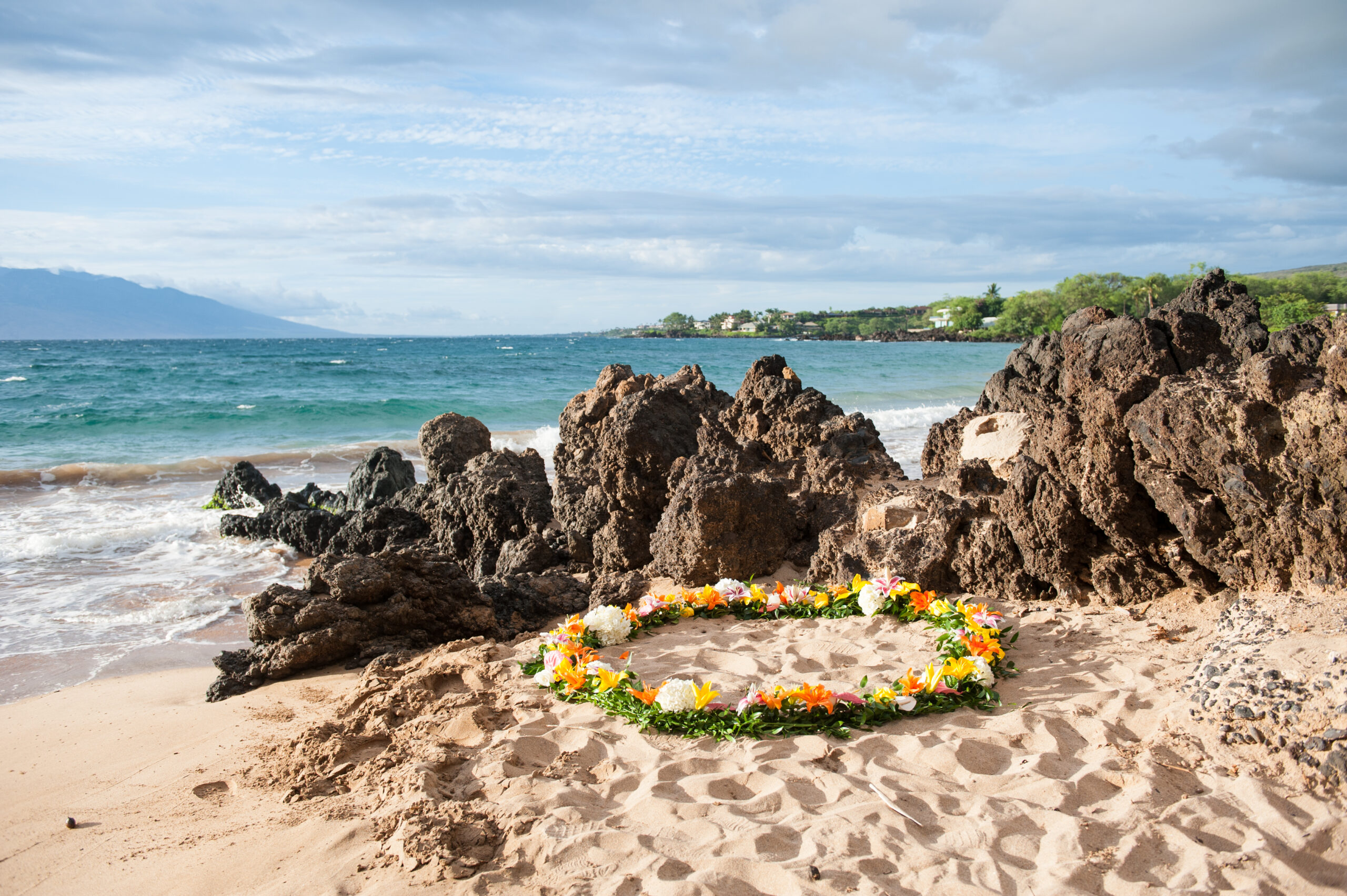
A Hawaii destination wedding is the easiest legal wedding an American couple can have outside their own state. No passport, no apostille, no translation, no residency requirement, no waiting period, and no blood tests. You apply for the license online, meet an agent in person, and you’re clear to marry. Nowhere in the Caribbean or Mexico comes close to that.
What Hawaii asks in exchange is a different kind of destination wedding planning. There’s no all-inclusive resort model here, so instead of choosing a package, you’ll be assembling a wedding piece by piece: venue, officiant, catering, florals, photography, and a beach permit if you want to marry on the sand.
This guide walks you through every step, in order, so you know exactly what’s coming and when. Our Certified Destination Wedding Specialist can help you decide which one fits your timeline and priorities.
The Hawaii Wedding Process at a Glance
Most Hawaii weddings follow the same path. The total planning timeline runs roughly 12 to 18 months from “we’re getting married in Hawaii” to the wedding day itself. Here’s the broad shape:
- Months 12 to 18 out: Set a budget, choose your island, pick a date, connect with a Certified Destination Wedding Specialist, book your venue and a local planner.
- Months 9 to 12 out: Lock in your room block, book your core vendors (photographer, officiant, florist, catering), send save-the-dates.
- Months 3 to 6 out: Send formal invitations, secure a beach permit if you need one, finalize the menu and timeline, plan group activities.
- Month before: Apply for your marriage license online, since it’s only valid for 30 days.
- Wedding week: Arrive, meet your license agent in person to collect the license, host welcome events, and exchange vows.
For the full legal details, see our Hawaii legal wedding guide. This piece focuses on the whole planning arc.
The Full Step-by-Step Hawaii Wedding Planning Process
Phase 1: Decisions Before You Book
Step 1: Understand How a Hawaii Wedding Actually Works
Start here, because Hawaii doesn’t work like the wedding destinations most couples compare it to. In Mexico or the Caribbean, you book an all-inclusive resort and the wedding package bundles the venue, the officiant, the flowers, the cake, the dinner, and the coordinator into one price. Hawaii is almost entirely a la carte.
Most properties don’t offer full bundled wedding packages, and you’ll contract separately for each element or hire a local planner to do it for you. That’s not a drawback so much as a different model, and it means your budget conversation looks different from the start. The upside is total flexibility over every choice. The downside is that nothing is included by default.
Step 2: Set Your Budget
Based on our own couple spend data, Hawaii runs about $4,798 for a couple’s accommodations across a typical five-night stay at roughly $480 per person per night, with airfare between $1,000 and $2,000 per couple. Add a venue and the total lands north of $12,000 for those elements alone. That number genuinely does not include food, drinks, decor, photography, florals, or entertainment, all of which you’ll be paying for separately.
Wedding services themselves run roughly $2,000 at the simplest end, around $5,000 for a mid-range celebration, and $10,000 and up for a full production. It’s also worth knowing that our Hawaii couples average just 2 guests, which tells you almost everything: Hawaii is overwhelmingly an elopement and micro-wedding destination. If that’s where you’re headed, our guide to elopements versus micro weddings is a useful next read.
Step 3: Pick Your Wedding Date
Hawaii’s weather is mild year-round, which makes the date decision more about crowds and cost than climate. April through October is the drier stretch across most of the islands. November through March brings more rain, especially on the windward and northern shores, along with the big winter surf that draws spectators to Oahu’s North Shore.
Peak tourist demand hits from mid-December through March and again from June through August, when rates and flight prices climb. Late April through early June and September through early November are the value windows.
One bonus for winter weddings: humpback whales are in Hawaiian waters roughly December through April, and on Maui you can often see them from shore.
Step 4: Choose Your Island
This is the biggest decision you’ll make, because the islands are genuinely different places.
Oahu is the most convenient: the most direct flights, the most hotel rooms, Waikiki’s walkable beachfront, and Honolulu’s restaurants and history. It’s the easiest island for guests and the busiest.
Maui has the deepest resort inventory, with the Wailea and Kaanapali coasts, the Road to Hana, and Haleakala’s summit sunrise.
Kauai, the Garden Isle, is the lushest and most dramatic, with the Na Pali cliffs and Waimea Canyon, quieter and more remote.
The Big Island is the most varied, with active volcanoes, black-sand beaches, and the sunny Kohala Coast resorts. Oahu for guest convenience, Maui for resorts, Kauai for scenery, the Big Island for range.
Phase 2: Booking and Planning
Step 5: Connect with a Certified Destination Wedding Specialist
Working with a Certified Destination Wedding Specialist is free for the couple. In Hawaii, where nothing bundles, that support does different work than it does in the Caribbean: it’s about matching you to the right island and property, structuring the room block, and coordinating guest travel across a state where inter-island flights may be part of the itinerary.
Many couples also hire a local island planner to handle vendor contracts and day-of logistics on the ground, and the two roles complement each other. Plan for 12 to 18 months of lead time for peak dates, and book photographers earlier than you’d expect, since the best ones fill their calendars far out.
Step 6: Choose Your Resort and Ceremony Venue
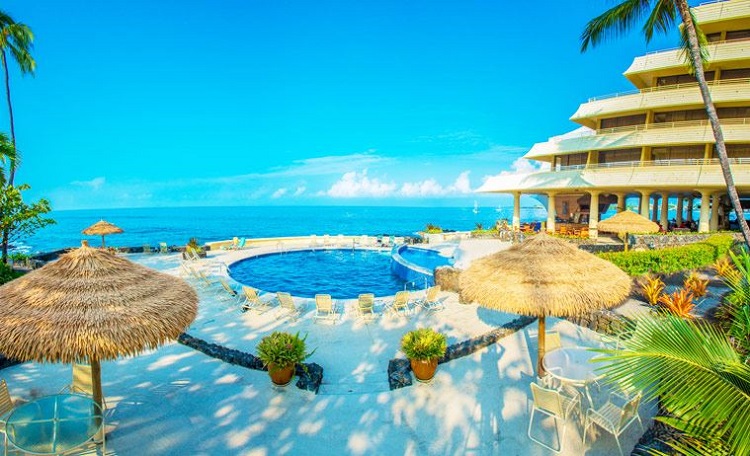
Match your resort to your island, your guest count, and your budget. Hawaii’s properties are hotels and resorts rather than all-inclusives, so confirm what a wedding at each one actually includes before you compare prices. Most have dedicated lawn, oceanfront, or garden ceremony sites, and using a resort’s own site avoids the state beach permit process entirely.
Popular Hawaii wedding properties include:
Alohilani Resort Waikiki Beach
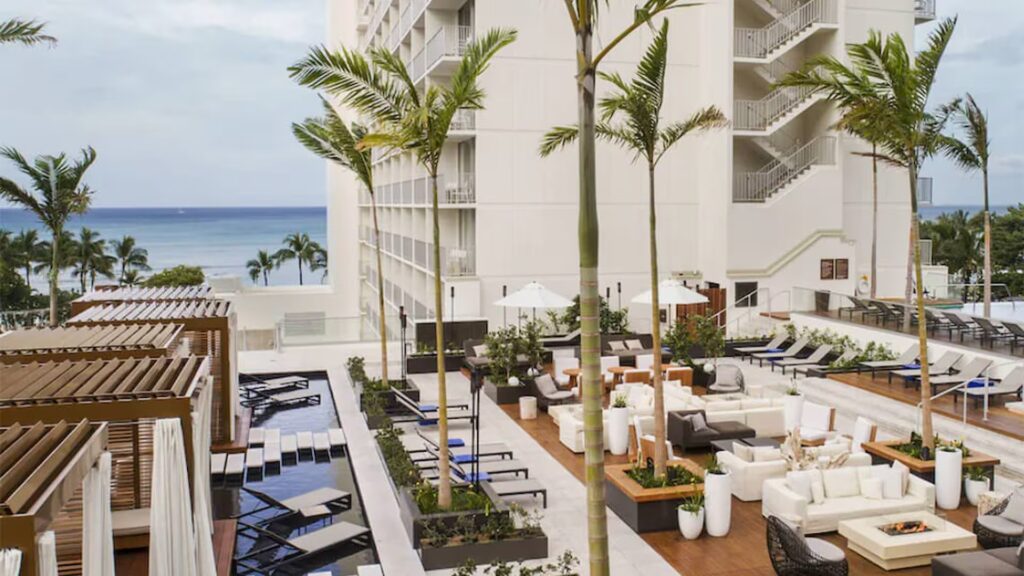
A contemporary property across from Waikiki Beach on Oahu, within walking distance of Honolulu’s restaurants, shopping, and Diamond Head views. Alohilani is one of the more accessible price points in Hawaii and works well for couples who want guests to be able to explore on foot without renting cars.
Learn more about Alohilani Resort Waikiki Beach and get a free quote today >>
Aulani, a Disney Resort & Spa
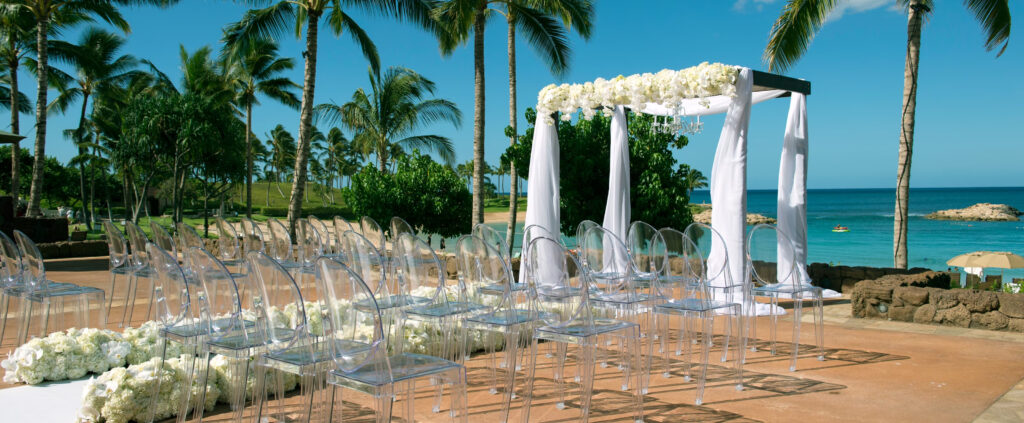
A family-focused resort on Oahu’s Ko Olina coast, built around Hawaiian storytelling and culture with lagoons, a water park, and extensive kids’ programming. Aulani is the clear pick when your guest list includes children, and you want them genuinely entertained across a multi-day wedding week.
Learn more about Aulani, a Disney Resort & Spa and get a free quote today >>
Fairmont Kea Lani
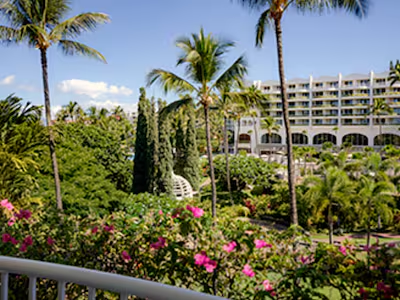
An all-suite luxury resort on Maui’s Wailea coast, with oceanfront lawns and the sunniest, driest weather on the island. Fairmont Kea Lani pairs a polished wedding operation with a stretch of coast that’s reliably clear when other parts of Maui aren’t, and the suite layout suits guests staying several nights.
Learn more about Fairmont Kea Lani and get a free quote today >>
Grand Hyatt Kauai Resort & Spa
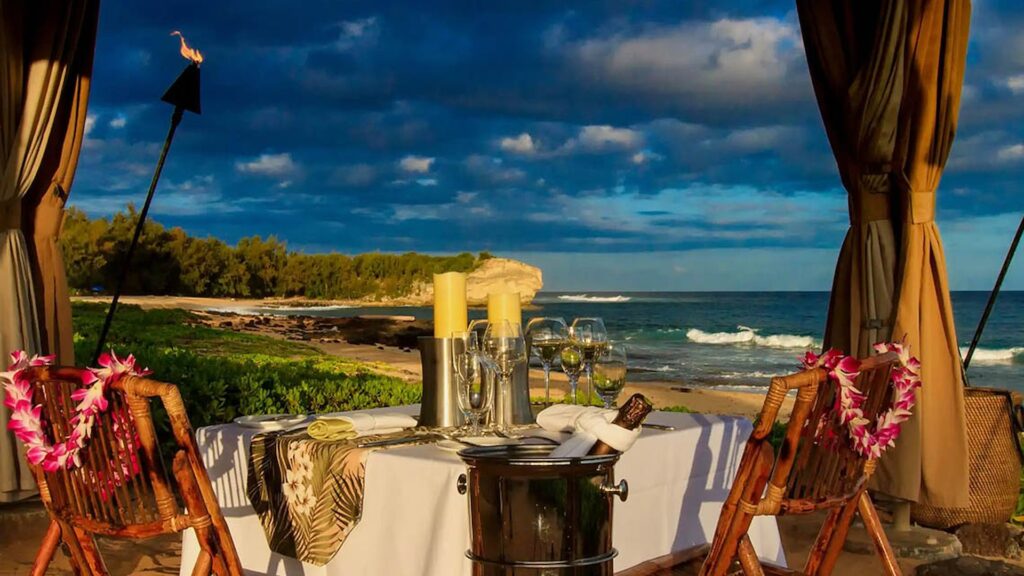
A large resort on Kauai’s sunny south shore at Poipu, with open-air architecture, saltwater lagoons, and gardens running down to the water. Grand Hyatt Kauai gives you the Garden Isle’s scenery with the infrastructure of a full-service resort, which is a rarer combination on Kauai than on Maui or Oahu.
Learn more about Grand Hyatt Kauai Resort & Spa and get a free quote today >>
Fairmont Orchid
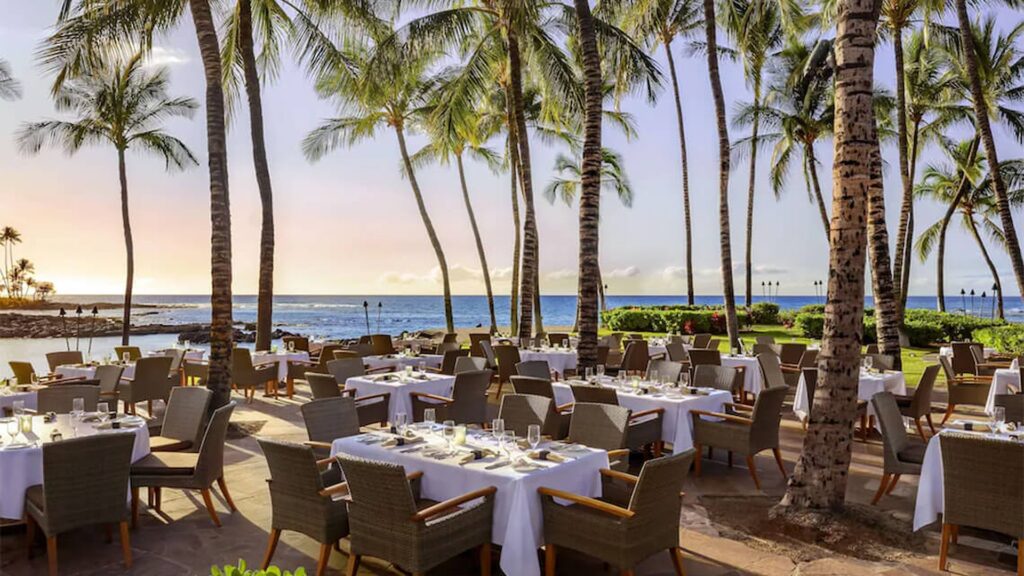
A resort on the Big Island’s Kohala Coast, set on a sheltered bay with a protected swimming cove and lava-rock landscaping. Fairmont Orchid sits on the island’s driest, sunniest side, and it puts volcano tours, black-sand beaches, and Waimea’s ranch country within reach for the wedding week.
Learn more about Fairmont Orchid and get a free quote today >>

Step 7: Lock In Your Room Block
A room block holds rooms at a negotiated group rate for your guests. Hawaii blocks work differently from the Caribbean model: because properties aren’t all-inclusive, hitting a room-night threshold usually earns you a discounted rate, a resort credit, or a complimentary suite night rather than a comped wedding package.
Ask specifically what the block unlocks, and factor in resort fees and parking, which are standard here and add meaningfully to your guests’ nightly cost. Flag those to guests up front so nobody is surprised at checkout.
Step 8: Book Your Vendors
This is the step that replaces “customize your package.” You’ll be contracting individually for an officiant, photography and videography, florals, catering or a private dining venue, music, hair and makeup, and rentals if your site needs chairs and an arch.
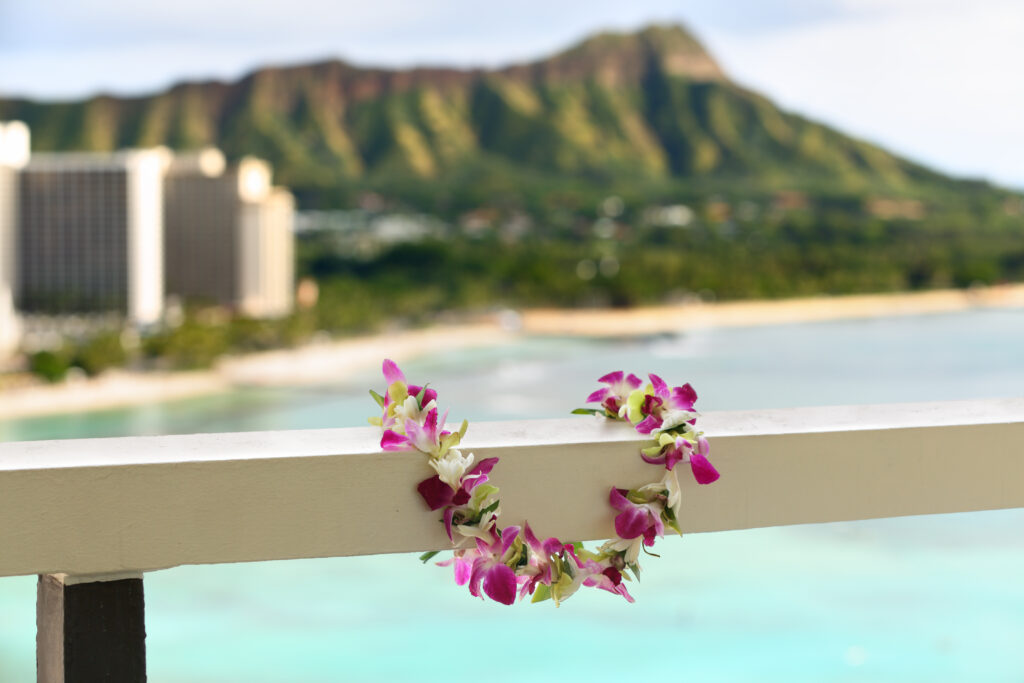
A local planner can assemble all of it, and on Kauai and the Big Island especially, that local knowledge is worth paying for. Hawaiian cultural elements are worth considering here too: a lei exchange between the couple and often between families, an oli or traditional chant to open the ceremony, a conch shell blessing, and a Hawaiian officiant who can weave the language and the protocol in properly.
These aren’t decorative add-ons; they’re the heart of a Hawaiian ceremony, so discuss them with a local officiant who can do them respectfully.
Phase 3: Pre-Travel Prep

Step 9: Apply for Your Marriage License and Beach Permit
Hawaii’s license is the simplest part of this whole guide, with one catch: it’s only valid for 30 days, so you apply close to the wedding, not months ahead. Start the application through the Hawaii Department of Health’s online system, then both of you appear in person before a licensed marriage license agent with government-issued photo identification to collect it. There’s a license fee plus a small administrative fee.
No waiting period, no residency requirement, no blood tests, and no witnesses required.
Separately, if you’re marrying on a public beach or in a state park rather than on resort property, you’ll need a permit from the state, which is inexpensive and which your planner or photographer usually secures. Remember that public beaches stay public, so a beach ceremony isn’t a private one. Requirements can change, so confirm the current process with the Hawaii Department of Health before you finalize.
Step 10: Send Invitations and Coordinate Guest Logistics
Send save-the-dates 10 to 12 months out, earlier than you would for a Caribbean wedding, because Hawaii flights are long, expensive, and eat more vacation days. Formal invitations follow 3 to 4 months ahead, with the room-block deadline noted.
Be specific about airports: Honolulu for Oahu, Kahului for Maui, Lihue for Kauai, and Kona or Hilo for the Big Island. Guests flying from the East Coast should expect a full travel day and a significant time change, so build in recovery time before the first event. Mention whether they’ll need a rental car, which they very likely will outside Waikiki.
Add group activity ideas: a luau, a snorkel catamaran, the Road to Hana on Maui, Waimea Canyon on Kauai, Volcanoes National Park on the Big Island, and Pearl Harbor on Oahu.
Our RSVP and guest communication timeline maps out when to send what.
Step 11: Finalize the Details
Two to four months out, finalize the ceremony script, florals, photography and videography, music, hair and makeup, attire, welcome bags, and the day-of timeline with your planner. Hawaii is warm but breezy, and evenings at elevation can be genuinely cool, so plan attire for your specific site.
Schedule the ceremony to catch the light about an hour before sunset, and confirm the sunset time for your date, since it shifts more across the year than people expect. Confirm your license agent appointment now.
Phase 4: In Destination
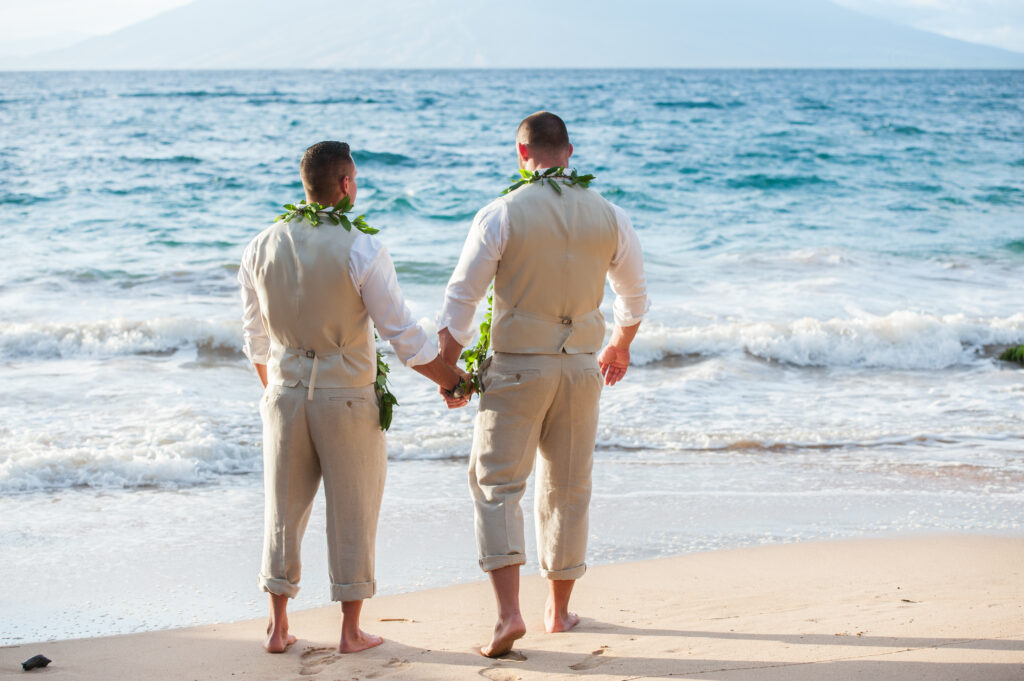
Step 12: Arrive in Hawaii and Collect Your License
There’s no residency requirement, so you can arrive and marry the same week. What you do need is an in-person appointment with your marriage license agent, with both of you present and carrying photo identification. Most couples arrive three to four days early to handle that, adjust to the time change, host welcome events, and give guests a buffer against long-haul flight delays.
Step 13: The Ceremony
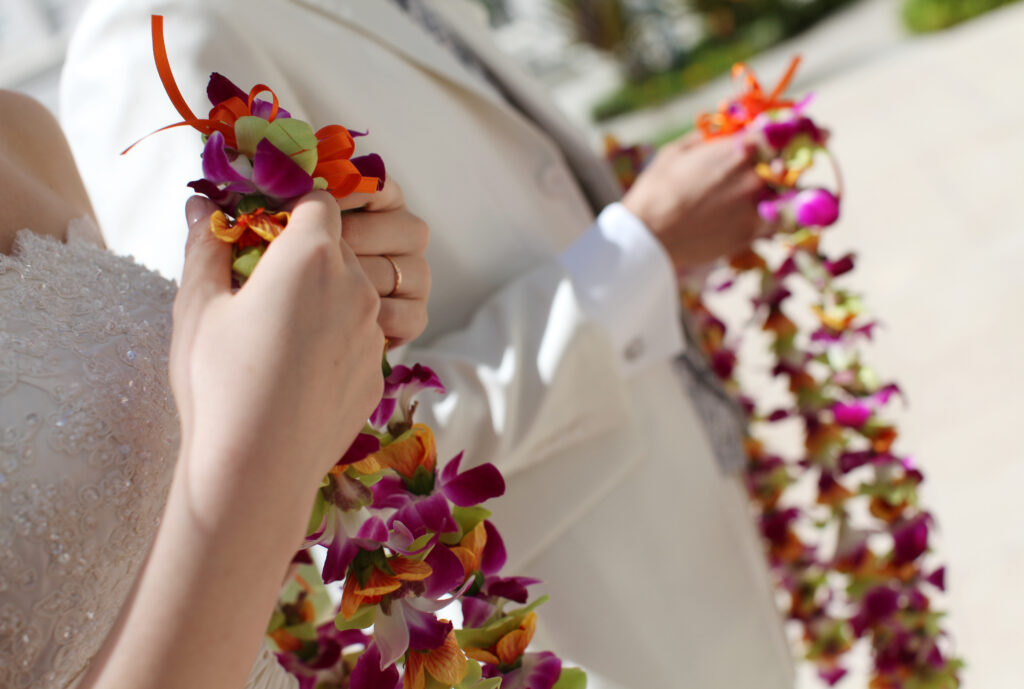
Your planner or coordinator runs the day-of timeline. Your officiant performs the ceremony, and Hawaii requires no witnesses, though most couples have them anyway. A Hawaiian ceremony often opens with a conch shell blast and an oli, moves through the vows, and includes a lei exchange, with the officiant explaining the meaning of each element for guests who haven’t seen it before. The reception follows, and if you’re doing a luau-style dinner or hula performance, that usually anchors the evening.
Phase 5: After the Wedding
Step 14: Get Your Marriage Certificate
This is the easiest post-wedding step of any destination in this series. Your officiant files the license with the state, and because Hawaii is a US state, your marriage is automatically valid in every other state with no apostille, translation, or foreign registration required. Order certified copies of the marriage certificate through the Hawaii Department of Health, either before you leave or online afterward.
Keep several on hand for name changes and taxes. Our wedding paperwork checklist covers what to hold onto.
Ceremony Options in Hawaii
Hawaii is simpler than the international wedding destinations in one important way: there’s no separate civil-versus-symbolic distinction to navigate. Any ceremony performed by a licensed officiant with a valid license is legally binding, whatever form it takes.
Civil Ceremony (Legally Binding)
Any officiant licensed by the State of Hawaii can perform a legally binding ceremony, and that includes judges, ministers, and independent celebrants who’ve registered with the state. There’s no government office you have to visit for the ceremony itself, no required witnesses, and no waiting period. You can marry on a resort lawn, a permitted beach, a mountainside, or a boat, and it counts the same.
Religious Ceremony (Also Legally Binding)
A religious ceremony performed by a licensed officiant is legally binding on its own, with no separate civil step needed. Hawaii has historic churches on every island, including the coral-block churches built in the 1800s, and many couples hold a church ceremony followed by a reception at their resort.
Traditional Hawaiian Ceremony
A traditional Hawaiian ceremony, led by a kahu, incorporates the oli chant, the pu conch shell, a lei exchange, and often a water blessing with a ti leaf. Performed by a licensed kahu, it’s fully legally binding. Approach it as a cultural practice rather than a theme, work with a kahu who can explain the protocol and the meaning, and it becomes the most memorable part of the day for everyone present.
Symbolic Ceremony
Because the legal process is so easy here, very few couples need a symbolic ceremony in Hawaii. It still makes sense if you’re already legally married and celebrating with family, or if you want a vow renewal. Any resort or planner can arrange one, and it removes the license step entirely.

Hawaii Wedding Planning FAQs
How long does the entire Hawaii wedding planning process take?
Plan for 12 to 18 months, driven almost entirely by venue and vendor availability rather than paperwork. Photographers and planners on the smaller islands book out especially far. The marriage license itself is a last-month task, since it’s only valid for 30 days.
Do we need to be in Hawaii before our wedding?
There’s no residency requirement or waiting period. You do need to appear in person before a licensed marriage license agent with your partner and photo identification to collect the license, so build a day in for that. Most couples arrive three to four days early anyway, given the flight length and time change.
Do we need a passport to get married in Hawaii?
Not if you’re a US citizen. Hawaii is a US state, so domestic travelers need only standard identification for the flight and government-issued photo identification for the license appointment. There’s no apostille, no translation, and no foreign registration afterward, which makes it the simplest legal path of any destination wedding location.
How much should we expect to spend on a Hawaii wedding?
Accommodations, airfare, and a venue for a couple total more than $12,000 based on our own couple spend data, with hotel costs averaging $480 per person per night. Importantly, that figure covers travel and venue only. Food, drinks, decor, florals, photography, and entertainment are all contracted separately in Hawaii and are not included, so plan for those on top. Wedding services themselves range from around $2,000 at the simplest end to $10,000 and up for a full celebration.
Why is Hawaii more expensive than the Caribbean or Mexico?
Two reasons. First, room rates are high, and resort fees and parking charges get added on top. Second, and more significantly, Hawaii has essentially no all-inclusive resort market, so nothing is bundled. In Mexico, a package might fold your ceremony, dinner, drinks, cake, and coordinator into one price. In Hawaii, you’re buying each of those separately at retail. That’s why Hawaii skews so heavily toward elopements and very small weddings.
Can we get married on a public beach in Hawaii?
Yes, with a permit from the state, which is inexpensive and usually arranged by your planner or photographer. Two things to understand: public beaches remain open to the public during your ceremony, so you won’t have the space to yourselves, and permits come with rules about setup, including limits on chairs, arches, and anything staked into the sand. A resort lawn or private venue avoids all of that.
Which island should we choose?
Oahu if guest convenience matters most, since it has the most flights, the most rooms, and the least need for rental cars if you stay in Waikiki. Maui for the deepest resort inventory and the most reliable resort-wedding infrastructure. Kauai for the most dramatic scenery and the quietest atmosphere, accepting that it’s smaller and more remote. The Big Island if you want variety in the wedding week, from volcanoes to beaches to ranch country.
Is same-sex marriage legal in Hawaii?
Yes. Hawaii has performed same-sex marriages since 2013, and the license process is identical for all couples. The islands have a long-standing reputation as a welcoming destination for LGBTQ+ travelers and couples.
Start Planning Your Hawaii Wedding Today
Hawaii offers something no international destination can: a legally effortless wedding in a place that still feels a world away. No passports, no apostilles, no consulate visits, just an online application and an afternoon with a license agent. What you get in return is volcanic coastline, a living culture with genuine ceremony traditions to draw on, and four very different islands to choose between. Just go in knowing that you’re building the wedding piece by piece rather than picking it off a menu.
The 14-step path above is the same one our Certified Destination Wedding Specialists walk every couple through, and the heavy lifting is on us.
Fill out our online wedding planning form and we’ll match you with a DW Specialist who knows these islands inside and out!

About the Author

Maggie Sabin
Maggie started as the SEO Manager at DestinationWeddings.com in 2024, where she works to drive organic traffic and conversions while creating meaningful, SEO-optimized content for the website. Previously, Maggie's career spanned from Human Resources & Recruitment to teaching at international schools for almost 10 years. Maggie spends her free time traveling, learning new languages, reading non-fiction books, working out, going to the beach and spending time cuddling her dog, Lola!