
Multicultural and interfaith weddings are increasingly common, and destination weddings are often the best format for celebrating them. The neutral tropical setting lets both traditions share equal space, and multi-day itineraries make room for full expressions of each culture or faith. Our Certified Destination Wedding Specialists have helped couples blend Hindu-Christian, Jewish-Catholic, Muslim-Buddhist, and many other combinations, and here’s the honest playbook for making it work.
Common Blend Formats
| Format | Structure | Best For |
|---|---|---|
| Co-Officiated | Two officiants share one ceremony | Couples who want a single unified ceremony with both traditions equally represented |
| Two-Part Ceremony | Two separate ceremonies on different days | Couples who want each tradition celebrated fully in its own space |
| Symbolic With Blended Rituals | Single symbolic ceremony with rituals from both traditions | Couples who value the cultural elements but not the religious structure of both |
| Sequential Ceremonies | Two ceremonies back-to-back on the same day | Couples who want both fully represented but on one wedding day |
Co-Officiated Ceremony
A co-officiated ceremony has two officiants (typically one from each tradition) sharing a single ceremony. Each officiant leads their portion of the ceremony in sequence, with unified vows or ring exchange in the middle.
Benefits:
- One ceremony instead of two logistically.
- Both traditions represented equally.
- Guests from both sides see their traditions honored.
Considerations:
- Officiants need to coordinate in advance on structure, timing, and content.
- Bringing officiants from home adds travel logistics.
- Some religious traditions restrict co-officiation with clergy from other faiths.
Two-Part Ceremony (Different Days)
A two-part ceremony format holds each tradition’s ceremony on its own day. For example, a Hindu ceremony on Day 1 and a Catholic ceremony on Day 2, with a shared reception on the second night.
Benefits:
- Each tradition gets its full form without compromise.
- Family from each side can travel for their tradition specifically if travel is limited.
- Reduces conflict between clergy or religious authorities.
Considerations:
- More wedding days mean more logistics and cost.
- Guests may need a longer stay.
- Multi-day format needs a resort with strong multi-event coordination.
Symbolic Ceremony With Blended Rituals
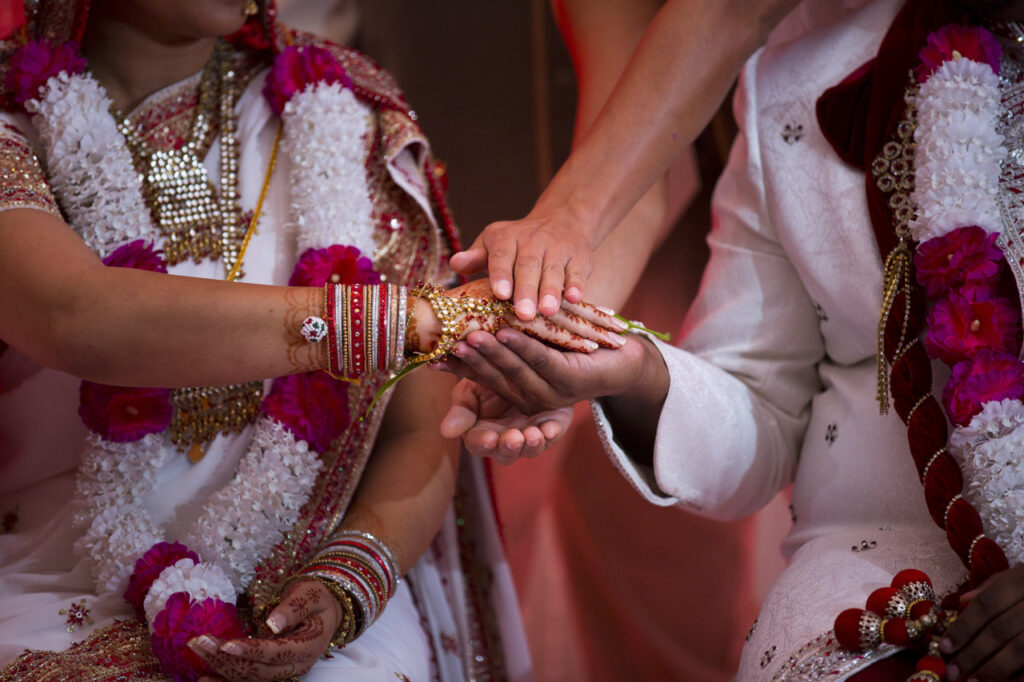
A single symbolic ceremony that layers in rituals from both traditions without full religious structure. For example: a beachfront ceremony with Jewish glass-breaking, Hindu garland exchange, Chinese tea ceremony, and traditional vows.
Benefits:
- Simpler logistics (one ceremony).
- Cultural elements without full religious commitment.
- Common for interfaith couples who identify culturally but not religiously.
Considerations:
- May not satisfy religiously observant family members.
- Symbolic ceremonies aren’t legally binding at the destination (couples usually handle legal marriage at home).
Sequential Ceremonies (Same Day)
Two full ceremonies held back-to-back on the same day, typically with a break for meals or décor changeover. Popular for Hindu-Christian and Jewish-Catholic couples, where each tradition wants its full ceremony.
Benefits:
- Full religious representation for both traditions.
- Single wedding day for guests.
Considerations:
- Long day for the couple and guests.
- Requires two venue setups on the same day.
- Attire may change between ceremonies.

Menu Planning for Blended Weddings
The reception dinner is where cultural blending gets easy. Options:
- Dual-cuisine menu: main courses from each tradition (e.g., biryani and pasta stations).
- Cultural cocktail hour + neutral dinner: heritage hors d’oeuvres for cocktail hour, then a menu both families enjoy.
- Dietary accommodation: Halal, kosher, vegetarian, Jain, and other requirements need coordination well in advance.
Music That Bridges Both Traditions
- Ceremony music from both traditions: sitar and organ, hora and salsa, mariachi and gospel.
- DJ with a bilingual or multi-tradition playlist: Bollywood, Latin, Jewish celebration music, English pop.
- Live musicians for key moments: cultural music for ceremony and cocktail hour, DJ for dance floor.
Family Communication
Family expectations are often the hardest part of a multicultural or interfaith destination wedding. Practical moves:
- Communicate ceremony format early: parents from both sides need to understand what will happen before the wedding week.
- Provide ceremony program cards: explain unfamiliar rituals so guests from each side understand what they’re witnessing.
- Assign a “cultural translator”: a friend or family member from each side who can explain traditions to unfamiliar guests during events.
- Address religious authority in advance: if bringing clergy from home, they may need to approve the ceremony structure.

Multicultural & Interfaith Wedding FAQs
Which format is easiest logistically?
The symbolic ceremony with blended rituals is the simplest. One ceremony, one setup, no religious authority coordination. It works well for couples who value cultural elements but don’t need full religious structure.
Can we bring our own clergy for the ceremony?
Yes. Most resorts & venues welcome bringing clergy from home, sometimes for a small outside-vendor fee. Coordinate their travel and accommodation as part of the wedding-week logistics.
What if our clergy won’t co-officiate?
This happens in some traditions. Options: use a two-part ceremony format (each clergy leads their own ceremony), use sequential ceremonies (each clergy leads their tradition back-to-back), or use one clergy plus a symbolic ceremony with rituals from the other tradition.
Do resorts have experience with multicultural weddings?
Yes, especially resorts in Mexico and the Caribbean properties that host large volumes of destination weddings. Ask specifically about the coordinator’s experience with your specific combination (Hindu-Christian, Jewish-Muslim, etc.) before booking.
How do we handle dietary restrictions across traditions?
Communicate all requirements (Halal, kosher, vegetarian, Jain, allergen restrictions) to the resort F&B team well in advance. Most experienced wedding resorts can accommodate multiple dietary requirements across a wedding week, but the menu planning needs 4 to 8 weeks of lead time.
Start Planning Your Destination Wedding Today!
Multicultural and interfaith weddings work beautifully at destination resorts because the neutral setting lets both traditions share equal space. Our Specialists have helped couples blend every major combination and know how to plan the format that fits your specific families and traditions.
Fill out our online wedding planning form, and one of our Certified Destination Wedding Specialists will help you plan a celebration that honors both sides.

About the Author

Maggie Sabin
Maggie started as the SEO Manager at DestinationWeddings.com in 2024, where she works to drive organic traffic and conversions while creating meaningful, SEO-optimized content for the website. Previously, Maggie's career spanned from Human Resources & Recruitment to teaching at international schools for almost 10 years. Maggie spends her free time traveling, learning new languages, reading non-fiction books, working out, going to the beach and spending time cuddling her dog, Lola!