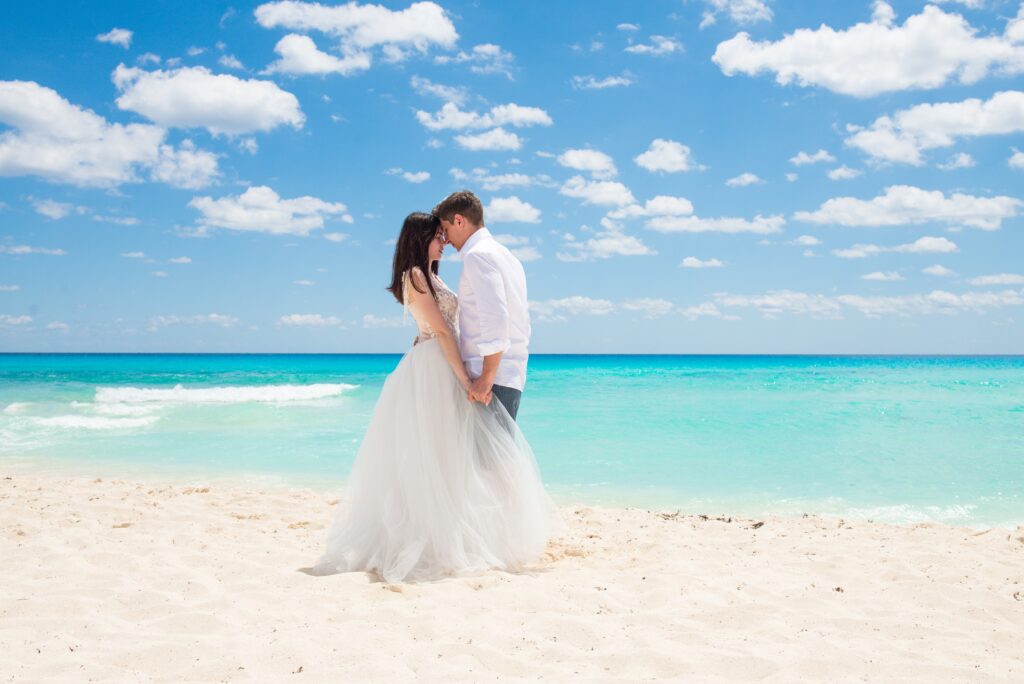
A destination wedding in the Bahamas sounds simple from the outside (pick an island, get on a plane, say your vows on the sand), and the legal side genuinely is. You need 24 hours in the country, a marriage license, and two witnesses. No blood tests, no apostilles, no translations. The Bahamas is also the closest tropical wedding destination to the US mainland, with Nassau barely 30 minutes in the air from Miami.
What takes more thought is the geography. This is an archipelago of more than 700 islands and cays, and the island you choose shapes everything: how easy the trip is for guests, what the wedding costs, and whether you’re marrying at a large resort or somewhere with a dozen rooms.
This guide walks you through every step, in order, so you know exactly what’s coming and when. Our Certified Destination Wedding Specialist can help you decide which one fits your timeline and priorities.
The Bahamas Wedding Process at a Glance
Most Bahamas weddings follow the same path. The total planning timeline runs roughly 12 to 18 months from “we’re getting married in the Bahamas” to the wedding day itself. Here’s the broad shape:
- Months 12 to 18 out: Decide on a legal or symbolic ceremony, set a budget, choose a date, pick your island, connect with a Certified Destination Wedding Specialist, choose your resort.
- Months 6 to 12 out: Lock in your room block, customize your package, send save-the-dates, gather your documents.
- Months 2 to 6 out: Send formal invitations, finalize vendors, plan group activities (Exuma sandbars, Blue Lagoon, a Harbour Island day, snorkeling), and confirm details with your coordinator.
- Wedding week: Arrive at least 24 hours ahead, apply for the license in person, host welcome events, and exchange vows.
- After the wedding: Collect your marriage certificate and file the certified copy at home.
For the full legal details, see our Bahamas legal wedding guide. This piece covers the whole planning arc.
The Full Step-by-Step Bahamas Wedding Planning Process
Phase 1: Decisions Before You Book
Step 1: Choose Between a Legal and a Symbolic Ceremony
The Bahamas makes this an easy call. A legal ceremony requires 24 hours in the country before you apply, a marriage license from the Registrar General, and two witnesses. Documents are already in English, so there’s no translation or apostille step, and there are no medical tests. Both of you apply in person.
A symbolic ceremony skips even that and moves the legal filing home. Most couples marrying here go legal, simply because the process asks so little. Same-sex couples should know the Bahamas doesn’t currently perform same-sex marriages, so a symbolic ceremony is the route there.
Step 2: Set Your Budget
A note on the numbers here. We don’t hold Bahamas-specific spend data the way we do for our highest-volume wedding destinations, so rather than borrow another island’s averages, here’s the honest regional picture: across the Caribbean, our couples spend an average of $10,705 all-in, covering the wedding package, accommodations, airfare, and add-ons, with a realistic range of roughly $5,000 to $17,000 and up. Regional hotel costs average about $415 per person per night.
Treat the Bahamas as sitting at the higher end of that band, because room rates in Nassau, Paradise Island, and the Out Islands generally run above the regional norm, while airfare runs below it thanks to the short hop from Florida. Your Certified Destination Wedding Specialist can price your specific resort and guest count precisely. Budget separately for the marriage license, the notarized affidavit, and the officiant’s fee.
Step 3: Pick Your Wedding Date
December through April is the dry season and the most dependable window for an outdoor ceremony, with comfortable temperatures and low humidity. It’s also peak season, so rates and lead times climb, especially over the winter holidays. Hurricane season runs June through November, and unlike Aruba or Curacao further south, the Bahamas sits squarely in the storm belt, with September and October carrying the most risk. If you marry in those months, take travel insurance seriously and lock in an indoor backup.
May and November are the shoulder months worth targeting. One local date to know: Junkanoo, the national street parade, takes over Nassau on Boxing Day and New Year’s Day. Spectacular to witness, complicated to marry around.
Our guide to the best time to get married in the Caribbean has the wider regional view.
Step 4: Choose Your Island
This is the decision that shapes everything else.
Nassau and Paradise Island hold most of the country’s resort inventory, the main international airport, and the widest choice of wedding venues. They’re the easiest option for guests by a distance.
Grand Bahama Island, around Freeport, is quieter and generally better value, with its own airport.
Exuma is the postcard version: 365 cays, impossibly clear water, the famous swimming pigs, and a handful of small luxury properties.
Harbour Island and Eleuthera deliver the pink sand beaches and a boutique, barefoot-chic feel.
The wider Out Islands, including Andros, the Abacos, and Cat Island, are the most remote and the most private. Nassau for convenience and scale, Grand Bahama for value, Exuma and Harbour Island for the scenery people fly here for.
Phase 2: Booking and Planning
Step 5: Connect with a Certified Destination Wedding Specialist
Working with a Certified Destination Wedding Specialist is free for the couple, since they are paid by the resort partners. In the Bahamas, the value is mostly in the island choice and the connecting flights. Getting to Exuma or Harbour Island usually means a second flight or a ferry after Nassau, which is fine for a small group and a real burden for a large one. A DW Specialist will tell you honestly whether your guest list suits the island you’ve fallen for. Plan for 12 to 18 months of lead time for peak-season dates.
Step 6: Choose Your Resort and Ceremony Venue
Match your resort to your guest count, your island, and your budget. Bahamian properties range from large all-inclusive resorts to twelve-room private cays, so capacity varies far more here than in Mexico or the Dominican Republic. If you want something genuinely unusual, our roundup of unique Bahamas wedding venues covers private cays, historic estates, and off-grid options.
Popular Bahamas wedding anchors include:
Sandals Royal Bahamian
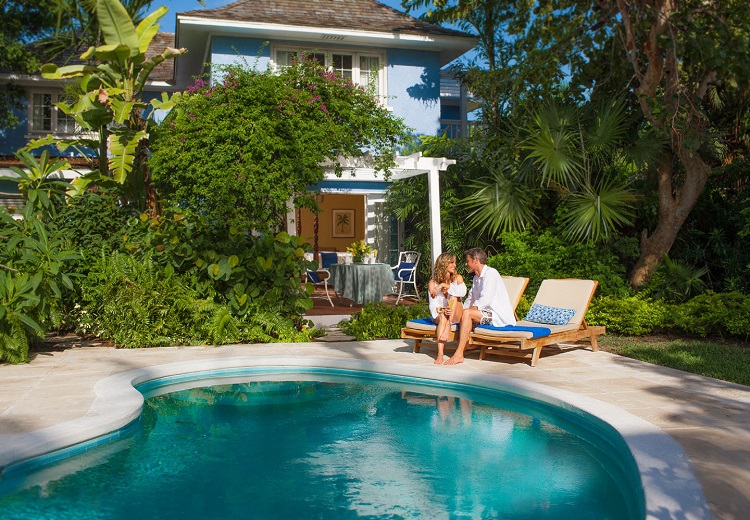
An adults-only luxury resort just west of Nassau, with a private offshore island included in the stay and multiple ceremony settings between the two. Sandals Royal Bahamian runs a deep wedding operation and supports both symbolic and legal ceremonies, which makes it the most turnkey choice in the country.
Learn more about Sandals Royal Bahamian and get a free quote today >>
Riu Palace Paradise Island
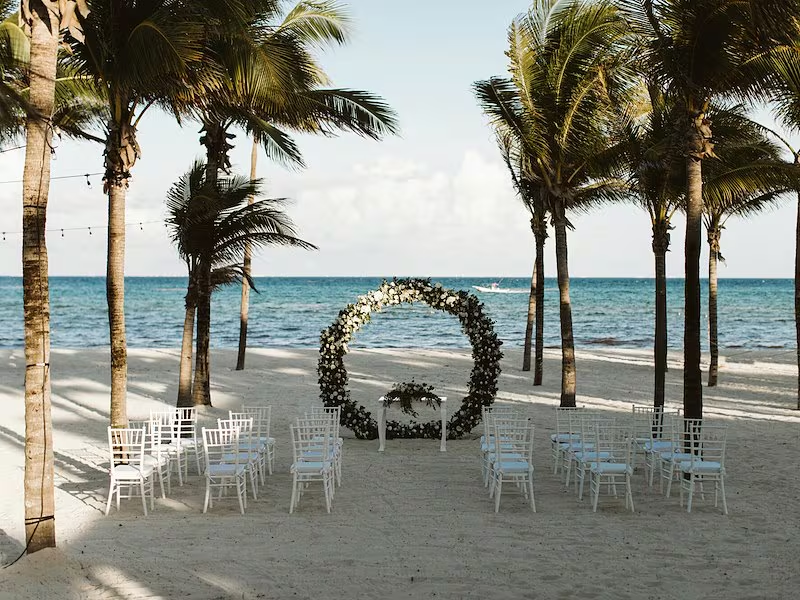
An adults-only all-inclusive on Paradise Island, steps from Cabbage Beach and a short walk from the Atlantis complex. Riu Palace Paradise Island hosts legally binding civil ceremonies and offers good value for the location, with guests within easy reach of Nassau’s restaurants and nightlife.
Learn more about Riu Palace Paradise Island and get a free quote today >>
Warwick Paradise Island Bahamas
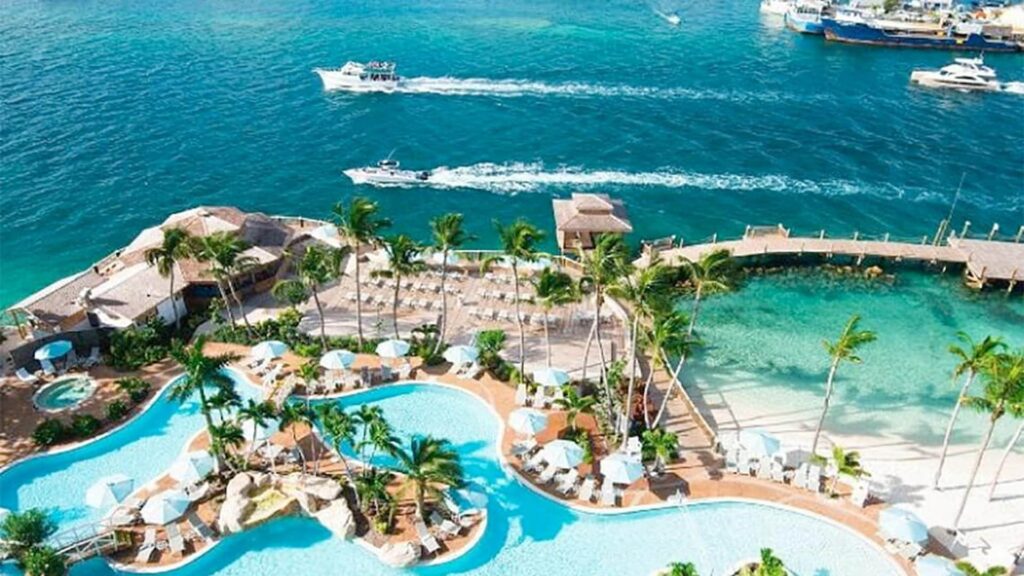
An adults-only all-inclusive with a quieter, more contained feel than its Paradise Island neighbors. Warwick Paradise Island supports symbolic and civil ceremonies and suits couples who want the convenience of Nassau without a sprawling mega-resort around them.
Learn more about Warwick Paradise Island Bahamas and get a free quote today >>
Viva Fortuna Beach by Wyndham
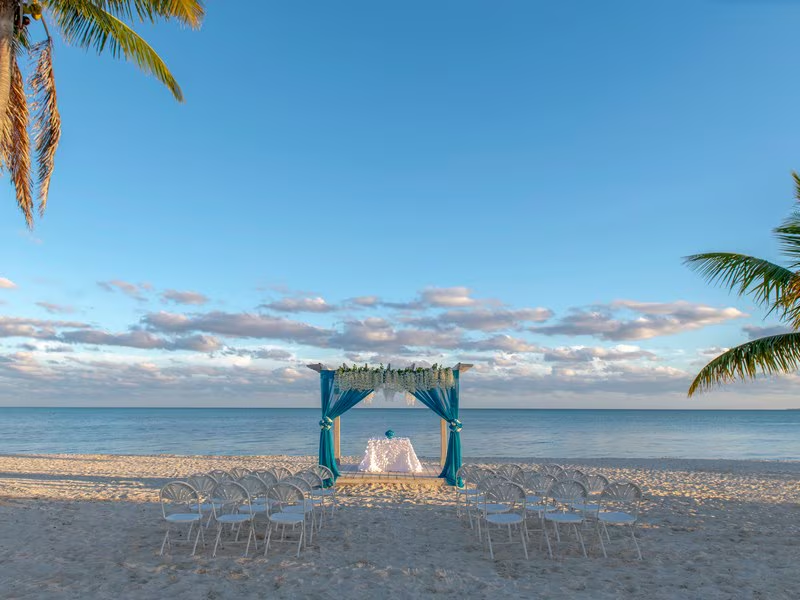
A family-friendly all-inclusive on Grand Bahama Island at the most accessible price point on this list. Viva Fortuna Beach handles Catholic, Jewish, South Asian, symbolic, and civil ceremonies, making it the most flexible property in the country for couples blending traditions or bringing a mixed-age guest list.
Learn more about Viva Fortuna Beach by Wyndham and get a free quote today >>
Grand Hyatt Baha Mar
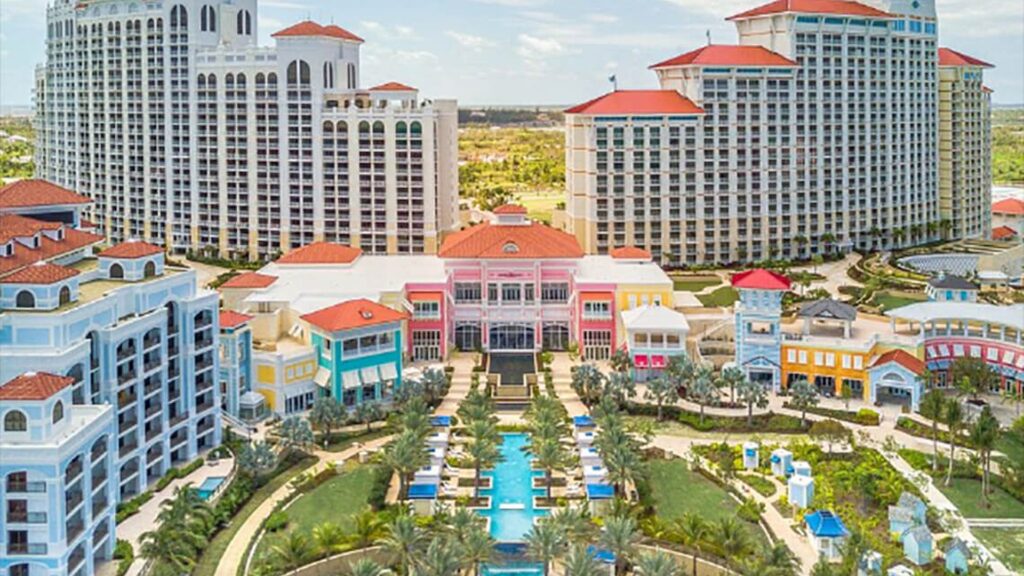
A large family-friendly resort within the Baha Mar complex on Nassau’s Cable Beach, with a casino, a water park, and genuine ballroom capacity. Grand Hyatt Baha Mar is the practical choice for guest counts that outgrow the island’s boutique properties, and there’s enough on site to keep every age group occupied all week.
Learn more about Grand Hyatt Baha Mar and get a free quote today >>

Step 7: Lock In Your Room Block
A room block holds rooms at a negotiated group rate for your guests. Worth understanding before you plan around it: the Bahamas has a thinner all-inclusive market than Mexico or the Dominican Republic, and many properties here operate on a room-only or European plan, meaning your stay includes accommodations only, with meals, drinks, and activities available at an additional cost.
That also means hitting a room-night threshold often earns a discounted rate, a resort credit, or complimentary nights rather than a comped wedding package. Ask specifically what your block unlocks, and factor in resort fees and the government VAT, which are standard and add meaningfully to guest costs.
Step 8: Customize Your Wedding Package
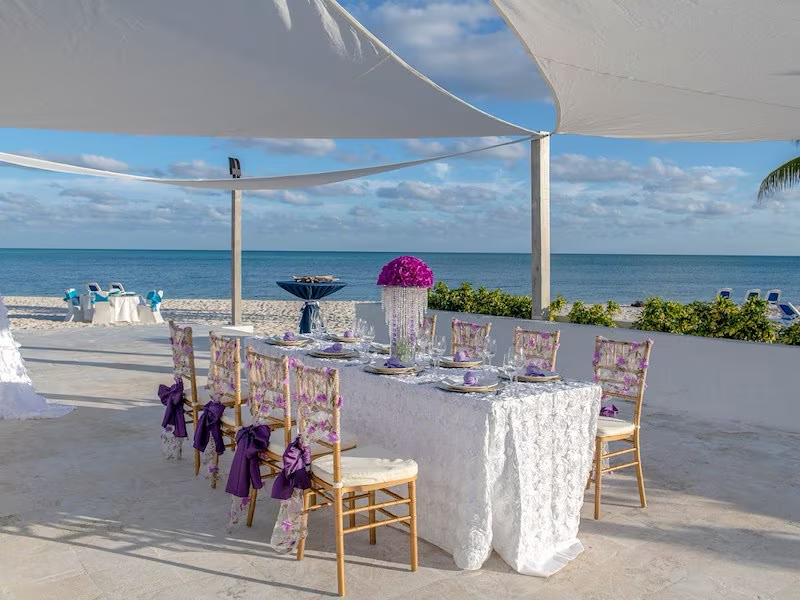
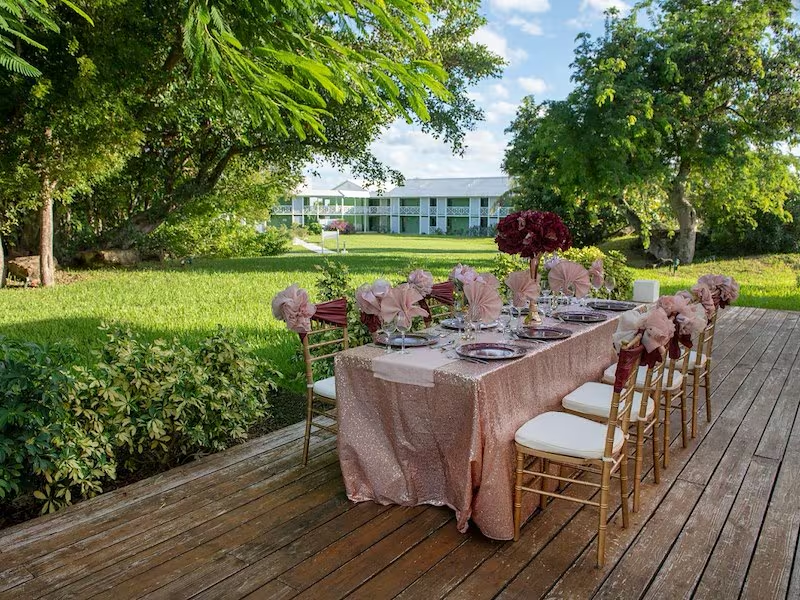
Your on-site coordinator handles ceremony setup, florals, music, photography, dinner, and bar service. Where a property doesn’t bundle a full package, you’ll be contracting some of these individually, so confirm early which model yours uses.
Local add-ons are the fun part here: a Junkanoo troupe in full costume for the reception entrance is unforgettable and unmistakably Bahamian, and a steel pan or goombay drum set works beautifully for cocktail hour. Menus built around conch salad, cracked conch, rock lobster, and guava duff give guests something they won’t get at home. If any of that belongs in your day, book it now.
Phase 3: Pre-Travel Prep

Step 9: Prepare Your Marriage License Documents
The paperwork is light, but a few pieces need sorting before you fly. You’ll need valid passports, the immigration card or entry stamp you receive on arrival, and a sworn declaration confirming you’re both single and free to marry, notarized locally. If either of you was previously married, bring the final divorce decree or the death certificate.
Everything is in English, so there’s no translation or apostille requirement. You’ll also need two witnesses aged 18 or over, which your resort can provide if you’re eloping. One scheduling detail to build around: Bahamian law requires ceremonies to take place between 6:00 AM and 8:00 PM, so a late-evening ceremony isn’t an option. Your resort coordinator will typically arrange the license appointment and the officiant.
Legal requirements do change, so confirm the current process with the Bahamian consulate or High Commission in your home country before you finalize anything.
Step 10: Send Invitations and Coordinate Guest Logistics
Send save-the-dates 9 to 12 months out and formal invitations 3 to 4 months before the wedding, with the room-block deadline noted.
The Bahamas has a real advantage worth putting in writing for guests: Nassau is roughly 30 minutes from Miami and under three hours from most of the US East Coast, with direct service from a long list of cities. Be explicit about which airport, though, because it’s where things go wrong. Nassau’s Lynden Pindling International Airport serves New Providence and Paradise Island. Grand Bahama, Exuma, and North Eleuthera have their own airports, and reaching them often means a connection through Nassau or a ferry. Nassau also has US pre-clearance, so guests clear US customs before boarding home and land domestically.
Mention that the Bahamian dollar runs one-to-one with the US dollar and US currency is accepted everywhere. Add group activity ideas: the Exuma swimming pigs, Blue Lagoon Island, Thunderball Grotto, the pink sands of Harbour Island, and Atlantis for families.
Our RSVP and guest communication timeline maps out when to send what.
Step 11: Finalize the Details
Two to four months out, finalize ceremony scripting, florals, photography and videography, music, hair and makeup, attire, welcome bags, and the day-of timeline with your coordinator. The Bahamas is warm and breezy year-round, and the trade winds off the Atlantic are stronger than most couples expect, so raise wind with your florist and skip anything unweighted. Confirm your officiant, your witnesses, and your license appointment now, and check your ceremony time against that 8:00 PM cutoff.
Phase 4: In Destination
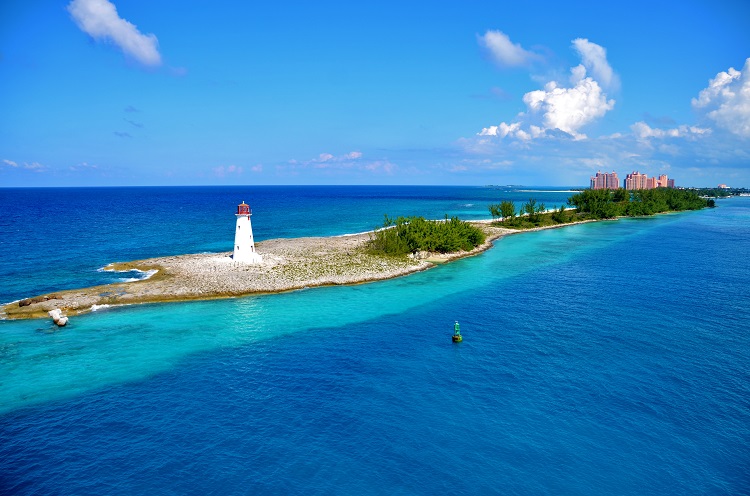
Step 12: Arrive and Apply for Your License
You need to have been in the country 24 hours before applying, and both of you must appear in person to collect the license. In Nassau, that means a trip to the Registrar General’s office, which your coordinator will usually arrange and accompany you to. Plan to land at least two full days ahead so a delayed flight or a public holiday closure doesn’t put the paperwork at risk. Most couples arrive three days early anyway for welcome events.
Step 13: The Ceremony
Your coordinator runs the day-of timeline. A licensed marriage officer or minister performs the ceremony in English, and your two witnesses sign the register. Remember the 6:00 AM to 8:00 PM window when you set the time. Late afternoon is the sweet spot for both heat and light, and if you’re on a west-facing beach, the sunset does the rest. The reception follows, and a Junkanoo entrance with drums and cowbells is the single most Bahamian way to open it.
Phase 5: After the Wedding
Step 14: Register Your Marriage at Home
Bahamian marriage certificates are issued in English, so there’s no translation step. Your marriage officer files the register, and you can obtain certified copies from the Registrar General, often before you leave. File a certified copy with your county clerk or vital records office at home, and contact your country’s embassy or consulate if you want the certificate authenticated before departure.
Keep several copies for name changes, taxes, and immigration paperwork. Our wedding paperwork checklist covers what to hold onto.
Ceremony Options in the Bahamas
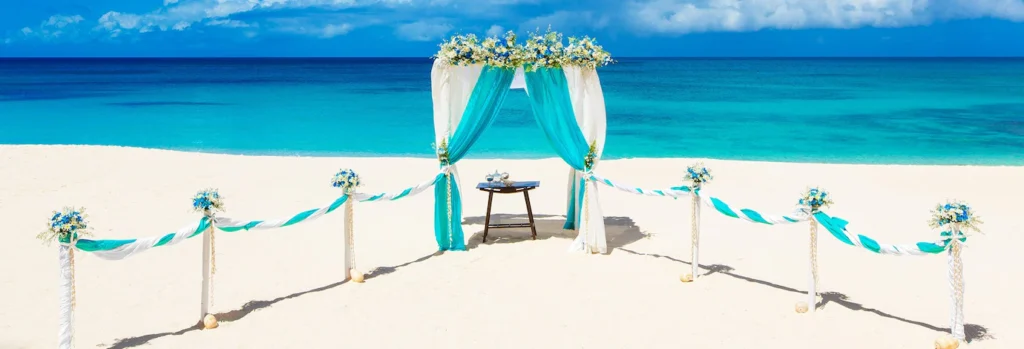
There are three ways to say “I do” in the Bahamas. Two of them can be legally binding.
Civil Ceremony (Legally Binding)
A civil ceremony performed by a licensed marriage officer is legally binding and internationally recognized. It requires the marriage license, 24 hours in the country beforehand, and two witnesses. With no blood tests, no apostilles, and no translations, this is the route most couples take, and resort coordinators handle it routinely.
Religious Ceremony (Also Legally Binding)
An ordained minister registered as a marriage officer can perform a ceremony that’s both religious and legally binding in a single service, with no separate civil step. The Bahamas has a strong church tradition, and some beautiful historic churches around Nassau, and several resorts maintain relationships with local clergy. Religious ceremonies need longer lead times and may carry extra requirements from the denomination, so raise this early.
Symbolic Ceremony
A symbolic ceremony carries no legal weight, and you complete the filing at home before or after the trip. Fewer couples choose it here than in destinations with heavier paperwork, but it’s the right path when you want total freedom over the script, when you’re already legally married, when you want to marry somewhere a marriage officer can’t easily reach, like a remote sandbar, or for same-sex couples, since the Bahamas doesn’t currently perform same-sex marriages.
Resorts across the islands host symbolic ceremonies without issue, and your Certified Destination Wedding Specialist can point you toward Caribbean destinations where legally binding same-sex ceremonies are available.

Bahamas Wedding Planning FAQs
How long does the entire Bahamas wedding planning process take?
Plan for 12 to 18 months for peak-season dates between December and April, and 18 months or more over the winter holidays. On the smaller islands, the property itself is usually the constraint rather than the paperwork, since boutique resorts have few rooms and book out early. Shoulder-season dates can often come together in 9 to 12 months.
How long do we have to be in the Bahamas before the wedding?
Twenty-four hours in the country before you apply for the license, and both of you have to appear in person to collect it. In practice, arrive at least two full days ahead so a flight delay or a holiday office closure doesn’t derail the timing. Most couples come three days early for welcome events regardless.
Do we need blood tests to get married in the Bahamas?
No. There are no blood tests or medical exams, and because everything is in English, there’s no translation or apostille requirement either. The full legal requirement is passports, your immigration card, a notarized affidavit that you’re both free to marry, the license, an officiant, and two witnesses.
How much does a Bahamas wedding cost?
We don’t hold Bahamas-specific spend data, so the honest answer is a regional one: across the Caribbean, our couples average $10,705 all-in, with a realistic range of roughly $5,000 to $17,000 and up. Expect the Bahamas to sit toward the upper half of that, since room rates here generally run above the regional average, offset somewhat by cheaper airfare from the US. Add the license, affidavit, and officiant fees on top. Your Certified Destination Wedding Specialist can give you a real number for your resort and guest count.
Which Bahamian island should we choose?
Nassau and Paradise Island if guest convenience matters most, since they have the international airport, the most rooms, and the most direct flights. Grand Bahama for better value with its own airport. Exuma or Harbour Island for the water and sand people picture when they think of the Bahamas, accepting that guests will need a connecting flight or ferry and that properties are small. Guest count usually settles it.
Is there a time-of-day restriction on Bahamas weddings?
Yes, and it catches couples out. Bahamian law requires marriage ceremonies to be performed between 6:00 AM and 8:00 PM. A sunset ceremony is fine year-round, but a late-evening one isn’t permitted, so confirm your ceremony time against that window when you build the day-of timeline.
Can same-sex couples get married in the Bahamas?
The Bahamas does not currently perform or legally recognize same-sex marriages. Same-sex couples who want to celebrate here typically hold a symbolic ceremony at their resort and complete the legal marriage at home. If a legally binding Caribbean ceremony matters to you, your Certified Destination Wedding Specialist can recommend islands where that’s possible.
Start Planning Your Bahamas Wedding Today
The Bahamas is the easiest tropical wedding your guests will ever travel to. A short flight from the US, no passports-and-paperwork marathon, English everywhere, dollars that need no converting, and water that genuinely looks the way it does in the photographs. Pick the island that fits your group, give yourself a day on the ground for the license, and the rest of it is about as straightforward as a destination wedding gets.
The 14-step path above is the same one our Certified Destination Wedding Specialists walk every couple through, and the heavy lifting is on us.
Fill out our online wedding planning form, and we’ll match you with a DW Specialist who knows these islands inside and out!

About the Author

Maggie Sabin
Maggie started as the SEO Manager at DestinationWeddings.com in 2024, where she works to drive organic traffic and conversions while creating meaningful, SEO-optimized content for the website. Previously, Maggie's career spanned from Human Resources & Recruitment to teaching at international schools for almost 10 years. Maggie spends her free time traveling, learning new languages, reading non-fiction books, working out, going to the beach and spending time cuddling her dog, Lola!