
Your destination wedding guest list is rarely one kind of person. It’s grandparents who’ve never held a passport next to cousins who travel for work. Friends who’ll book the swim-up suite without blinking next to friends quietly working out whether they can afford the flight. Two families who may not share a language, a religion, or a comfort level with a five-hour flight, spending four days together in a place none of them chose.
Handled well, that mix becomes the best part of the week. Handled poorly, it becomes the thing you remember. The difference is almost never budget. It’s communication, and it’s planning for the specific people on your list rather than for a generic guest.
Here’s how our Certified Destination Wedding Specialists help couples do it.
Start Communicating Earlier Than You Think You Need To
Every problem on a diverse destination wedding guest list gets smaller with more notice. A guest who’s given ten months can request time off, watch airfare, and save. The same guest given four months has to decide immediately with whatever’s in their account that week. Early communication isn’t a courtesy here, it’s the single biggest lever you have.
Send Save-the-Dates 8 to 10 Months Out
Earlier than a hometown wedding, and earlier still if you’re marrying over a holiday week or somewhere that requires a connection. Guests are booking time off work, arranging childcare or elder care, and in some cases renewing a passport, which can take months on its own. Follow with formal invitations three to four months out, and make the room-block deadline impossible to miss.
Our RSVP and guest communication timeline maps out exactly when to send what.
Build a Wedding Website That Answers the Awkward Questions
A good wedding website does more than list the schedule. It should cover what the weather will actually be like, what to wear to each event, which airport to book and how long the transfer takes, whether guests need a passport and how much validity, what currency to bring, whether the resort is all inclusive and what that covers, and whether a rental car is necessary. Every question a guest has to email you about is a question ten other guests were too polite to ask.
Be Explicit About Who Pays for What
This is where most of the friction on a mixed guest list actually comes from.
State plainly what you’re hosting, which typically means the ceremony, the reception, the welcome party, and often a farewell brunch, and state just as plainly what guests cover, which is usually their own flights, rooms, and any optional excursions. Ambiguity is what breeds resentment. A guest who knows the number can plan for it. A guest who’s guessing will assume the worst version and may decline over a cost that was never going to be theirs.
Plan for a Real Range of Budgets

On almost any guest list, the gap between what your wealthiest guest can spend and what your most stretched guest can spend is wider than you’d guess, and nobody is going to volunteer where they sit on that scale. Build the week so both ends work without anyone having to announce which one they’re at.
Offer Multiple Room Categories in Your Block
Ask your Certified Destination Wedding Specialist to negotiate a block that spans price points rather than locking everyone into one category. A garden-view room and a swim-up suite at the same resort can differ substantially per night, and that spread lets guests self-select quietly. If your resort can’t offer real range, consider adding a second, more affordable property nearby, though keep it close enough that transfers between events stay simple.
Our guide to planning a destination wedding that’s easier on your guests’ wallets goes deeper on this.
Keep Optional Things Genuinely Optional
Group excursions, spa days, golf outings, and boat trips are wonderful, and they are also line items your guests are paying for. Present them as invitations rather than expectations, don’t schedule the whole week so tightly that opting out means missing everything, and never make an add-on the only chance to spend time with you. A guest who skips the catamaran shouldn’t feel like they skipped the wedding.
Make It Easy to Decline
Some people on your list won’t be able to come, and the reason is usually money or time off rather than unwillingness. Say early and in writing that you understand travel is a real commitment and that a no won’t be held against anyone. It costs you nothing, and it spares people the ordeal of constructing an excuse. Consider a livestream for guests who can’t travel, particularly older relatives.

Accommodate Different Cultures and Traditions
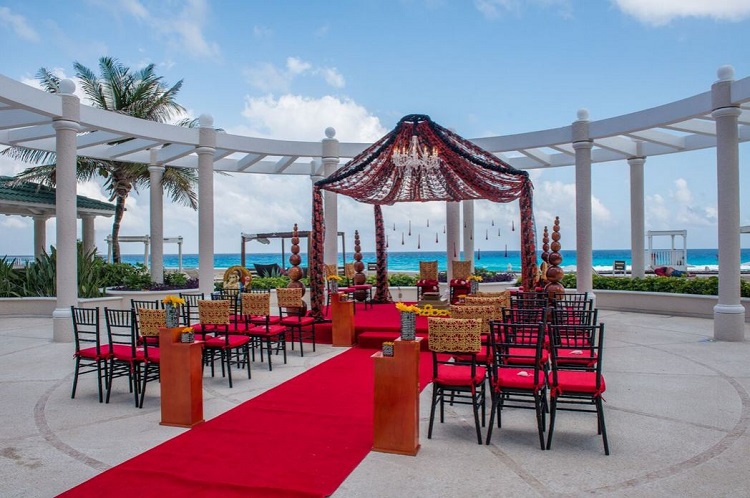
If you’re bringing two cultures together, the destination wedding format is unusually good at it, because you have several days rather than a single afternoon. That’s room for more than one tradition to get its proper moment instead of being compressed into a token gesture.
Blend Rather Than Choose
Multi-day programming is the advantage here. A mehndi or sangeet one evening, a ceremony that folds elements of both families into the structure, a welcome party that leans into one side’s food and music and a farewell brunch that leans into the other. Many resorts have real experience with Catholic, Jewish, South Asian, and other ceremony types, so ask directly what a property has actually hosted rather than what it says it can accommodate.
Tell Guests What They’re About to See
If half your guests have never attended a ceremony like the one you’re planning, a short explanation transforms the experience. A program note, a line on the wedding website, or a few sentences from your officiant explaining what’s happening and why turns polite observers into participants. This matters as much for a Mayan blessing or a Hawaiian lei exchange as it does for a religious rite.
Check the Legal and Cultural Ground First
Some wedding destinations are more welcoming than others, and the details are worth knowing before you fall for a resort. Legal recognition of same-sex marriage varies widely by country, and so do local attitudes. If you or members of your wedding party would be more comfortable somewhere with a strong track record, raise it with your Certified Destination Wedding Specialist at the shortlisting stage rather than after you’ve signed a contract.
Handle Dietary Needs and Accessibility Properly

These are the two areas where guests are least likely to speak up and most likely to have a difficult week if you don’t ask. Build the asking into your process so nobody has to volunteer it.
Collect Requirements Through Your RSVP
Put a free-text field on your RSVP rather than a checkbox list, because a checkbox list only captures what you thought of. You’re looking for allergies, religious requirements like halal or kosher, vegetarian and vegan preferences, and medical restrictions. Pass the full list to your resort coordinator well ahead of the final headcount, and ask specifically what the kitchen can genuinely deliver rather than accepting a general reassurance. A resort that can plate a vegetarian option may not be able to source halal meat on short notice.
Think Through Mobility Before You Book
Beach ceremonies are beautiful, and sand is very difficult to cross with a walker, a cane, or a wheelchair. Cliffside and hillside resorts often involve significant stairs between venues.
Before signing, ask about the route from guest rooms to each event space, whether golf-cart transport is available across a large property, whether beach access has a boardwalk or matting, and whether accessible rooms exist in the categories you’re blocking. If older or less mobile guests are central to your day, that constraint should shape the resort choice rather than being solved afterward.
Plan for Kids, or Plan for Their Absence
An adults-only resort is a perfectly valid choice, and it will determine who can come. Families with young children may not be able to leave them behind for four days, so decide early and communicate it clearly, because finding out from a room-block link is a bad way for a guest to learn. If children are welcome, a family-friendly property with a kids’ club buys parents real time to actually attend your events.
Our guide to multi-generational destination weddings covers this in more depth.
Support First-Time and International Travelers

On most guest lists, somebody is flying internationally for the first time. They will not tell you this. Assume they’re there and write your guest communications accordingly.
Passports, Documents, and Insurance
Flag passport requirements the moment you send save-the-dates, including the six-month validity rule most countries apply, since renewals can take months. Note any entry requirements or tourist cards. Recommend travel insurance plainly, especially for anyone traveling during hurricane season. Our wedding paperwork checklist is a useful thing to share directly with guests.
Take the Guesswork Out of Arrival
Arrival is where inexperienced travelers get most anxious. Tell guests exactly which airport to book, how long the transfer takes, and how they’ll get from the terminal to the resort. Arrange group transfers where you can. Give them a phone number that works locally and the name of the on-site contact. If several guests land within the same window, connecting them in advance so they can travel together turns a stressful arrival into the first fun part of the trip.
Manage Group Dynamics Across the Week
A destination wedding puts your guests together for days, not hours. That’s an opportunity, and it needs a little deliberate handling.
Use the Welcome Party to Mix People Early
The welcome party is your best tool for breaking up cliques before they harden. Formats where people stand and circulate work far better than a seated dinner: food stations rather than a buffet line, passed drinks rather than a bar queue, lawn games, or anything with a shared activity built in. Our roundup of creative ways to kick off your wedding weekend has formats that do this well.
Seat People to Build Bridges
Resist the instinct to seat every group with its own kind. Mix tables around a shared connection, whether that’s a hobby, a hometown, kids of similar ages, or a language in common, and put a natural connector at each table. If you have guests who speak different languages, seat a bilingual person with them rather than isolating them together.
Leave Real Gaps in the Schedule
The most common mistake on a multi-day wedding is programming every hour. Guests need unstructured time to nap, swim, explore, and recover, and older guests and families with small children need it more than anyone. A week with breathing room in it produces better attendance and better moods at the events that matter. Two anchor events a day is plenty.

Destination Wedding Guest List FAQs
How far in advance should we tell guests about a destination wedding?
Send save-the-dates 8 to 10 months out, and stretch that to 12 months for a holiday week or a destination requiring connecting flights. Formal invitations follow 3 to 4 months ahead. Guests on a mixed-budget list need the longest possible runway to book time off and find affordable airfare.
How do we handle guests who can’t afford the trip?
Give as much notice as possible, negotiate a room block spanning several price points, keep optional excursions genuinely optional, and say clearly that you understand if someone can’t make it. Don’t offer to pay for specific guests unless you can offer it to everyone in a similar position, since selective help gets noticed. A livestream is a good option for guests who can’t travel.
How do we accommodate multiple cultures at one destination wedding?
Use the multi-day format to your advantage rather than compressing everything into the ceremony. Give each tradition its own event where you can, build a ceremony that draws from both families, and explain what’s happening so guests unfamiliar with a rite can follow along. Ask resorts specifically which ceremony types they’ve hosted before, since experience varies a lot.
What’s the best way to collect dietary restrictions?
A free-text field on your RSVP, not a checkbox list, so guests can tell you things you didn’t think to ask about. Pass everything to your resort coordinator ahead of the final headcount and confirm what the kitchen can actually source rather than accepting a general assurance. Some requirements, particularly halal and kosher, need real lead time in some wedding destinations.
Should we choose an adults-only or family-friendly resort?
It depends on your list. If several guests have young children and can’t leave them for four days, an adults-only resort will cost you their attendance. If your list skews toward couples and friends without kids, adults-only gives a calmer week. Whichever you choose, communicate it with the save-the-dates so nobody discovers it later.
How do we make sure older guests can get around?
Ask about physical access before you book, not after. Check the route from rooms to each venue, whether the property runs golf carts, whether beach access has matting or a boardwalk, and whether accessible rooms are available in your blocked categories. Sand and stairs are the two things that most often catch couples out, and both are much easier to design around than to fix on the day.
Is it rude to have a destination wedding with a guest list this varied?
Not at all. A destination wedding asks more of guests than a hometown one, and the way you offset that is with notice, clarity, and genuine flexibility about who can come. Handled that way, most guests treat it as an invitation to a shared trip rather than an obligation, and the extra days together tend to produce closer relationships than a single reception ever does.
Start Planning Your Destination Wedding Today
A varied guest list isn’t a problem to solve; it’s the reason the week is worth taking. Our Certified Destination Wedding Specialists do this every day: matching couples to resorts that fit their actual group, structuring room blocks across price points, and thinking through the logistics so every guest arrives feeling looked after.
Fill out our online wedding planning form, and one of our DW Specialists will help you plan a celebration where every single person on your list feels like they belong there!

About the Author

Maggie Sabin
Maggie started as the SEO Manager at DestinationWeddings.com in 2024, where she works to drive organic traffic and conversions while creating meaningful, SEO-optimized content for the website. Previously, Maggie's career spanned from Human Resources & Recruitment to teaching at international schools for almost 10 years. Maggie spends her free time traveling, learning new languages, reading non-fiction books, working out, going to the beach and spending time cuddling her dog, Lola!