
Getting legally married in the Caribbean isn’t one process. Each island runs its own legal system, with residency requirements, document expectations, blood-test rules, and same-sex marriage law all varying widely from one destination to the next. Jamaica’s 24-hour residency with no apostille sits at one end of the spectrum; the Mexican Caribbean’s three-to-four-day residency plus apostille plus blood test sits at the other. This guide breaks down the Caribbean legal-marriage landscape by complexity so couples can pick the destination wedding that fits their planning timeline and document tolerance.
Short answer: Jamaica, Bahamas, and Anguilla are the simplest paths (24- to 48-hour residency, no apostille). The Mexican Caribbean coast (Cancun, Riviera Maya, Tulum) is the most paperwork-heavy. The Dominican Republic sits in the middle (no residency but apostilled docs sent 30 to 60 days ahead). Same-sex marriage is legal in Mexico, the US Virgin Islands, Curacao, the British Virgin Islands, and the Cayman Islands, but is not legal in most other Caribbean destinations.
For destination-specific deep dives, see our individual legal guides linked throughout this post. Our Certified Destination Wedding Specialists can help you plan every detail of your big celebration.
Caribbean Legal-Marriage Requirements at a Glance
| Destination | Residency | Apostille | Blood Test | Same-Sex Legal |
|---|---|---|---|---|
| Jamaica (Montego Bay, Negril, Ocho Rios) | 24 hours | Not required | No | No |
| Bahamas | 24 hours | Not required | No | No |
| Turks and Caicos | None | Not required | No | No |
| US Virgin Islands | 8-day waiting period after application | Not required (US territory) | No | Yes |
| Dominican Republic (Punta Cana) | None | Required (sent 30–60 days ahead) | No | No |
| Saint Lucia | 48 hours | Required | No | No |
| Barbados | None | Not required | No | No |
| Antigua | None | Not required | No | No |
| Aruba | None (for symbolic); complex for legal | Required for legal | No | Recognized (not performed) |
| Curacao | 2 days minimum | Required | No | Yes |
| Cayman Islands | None | Not required | No | Yes |
| Mexican Caribbean (Cancun, Riviera Maya, Tulum) | 3–4 business days | Required | Yes (HIV, syphilis) | Yes |
Three Ways to Exchange Vows in the Caribbean
Every Caribbean destination offers three core ceremony options. Only the civil ceremony is legally binding, but all three can stand alone as the wedding moment itself.
Civil Ceremony (Legally Binding)
A civil ceremony performed by a licensed local officiant (marriage officer, Justice of the Peace, civil registry judge, or notary public, depending on the country) is the only legally binding option. Requirements vary widely across the region: Jamaica’s process is among the simplest, while the Mexican Caribbean and Dominican Republic require more upfront paperwork. See destination-specific guides for full details.
Symbolic Ceremony (Most Popular)
The vast majority of Caribbean destination weddings are symbolic. Couples exchange vows, rings, and intentions without the paperwork, and handle the legal piece at home before or after the trip. Symbolic ceremonies have no document requirements, no health screening, no residency window, and full flexibility on ceremony scripting. Most all-inclusive wedding packages default to this option.
Religious Ceremony
Catholic, Protestant, and other religious ceremonies are available across the region. In most Caribbean destinations, religious ceremonies aren’t legally binding unless paired with a civil ceremony or performed by a marriage officer registered with the local government. Lead times are longer for religious ceremonies, so plan six to nine months out if specific denominations matter.
The Simplest Caribbean Legal-Marriage Paths
For couples wanting a legally binding ceremony with minimal paperwork friction, three Caribbean destinations stand out.
Jamaica (Montego Bay, Negril, Ocho Rios)
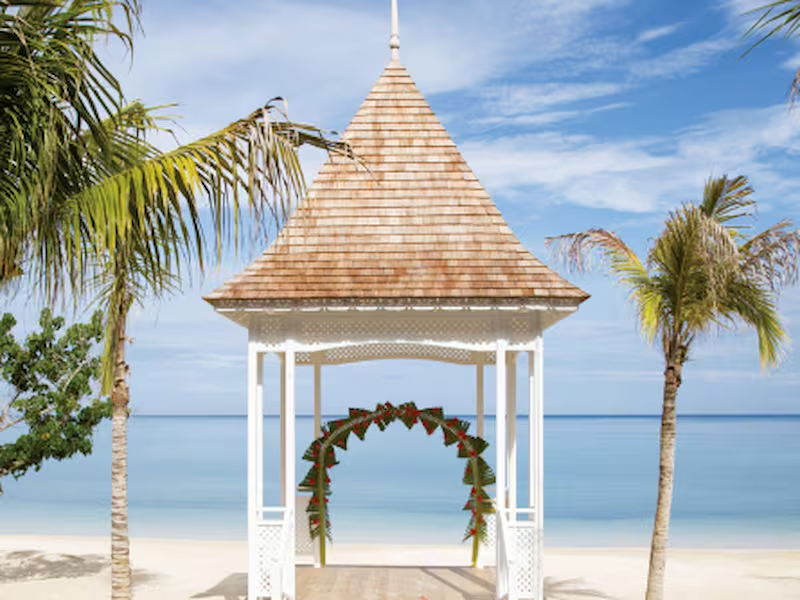
Jamaica’s 24-hour residency, no-apostille, no-blood-test process is among the simplest in the Caribbean. The marriage license costs roughly $40 USD and is processed in 24 hours. Most major Sandals, Beaches, Couples, and other all-inclusive resorts handle the paperwork on your behalf. For destination-specific detail, see our Jamaica legal guide and Montego Bay legal guide.
Bahamas
The Bahamas’s process is nearly identical to Jamaica’s: 24-hour residency, no apostille, no blood test, and a marriage license processed quickly through the Registrar General’s Department. The combination of the Bahamas’s extreme proximity to the US East Coast (Miami flights run under an hour) and the simple legal path makes the country one of the most practical Caribbean choices for couples wanting a quick, legally binding destination wedding.
Anguilla and the Cayman Islands
Anguilla requires 48 hours of in-country residency before the ceremony, but has no apostille or blood-test requirements. The Cayman Islands have no residency requirement at all and accept documents without apostille. Both destinations work well for couples wanting refined beach weddings with minimal paperwork friction.

Moderate-Complexity Caribbean Paths
Dominican Republic (Punta Cana, La Romana, North Coast)
The Dominican Republic has no residency requirement, which sounds simple until you discover the apostilled documents need to be sent 30 to 60 days before the wedding for Civil Registry review. The trade-off works well for couples who can plan ahead but don’t want a full pre-wedding week in the country. For destination-specific detail, see our Punta Cana legal guide.
Saint Lucia, Barbados, Antigua (Eastern Caribbean)
The English-speaking eastern Caribbean destinations sit in the middle of the complexity range. Saint Lucia requires 48 hours of residency and apostilled documents. Barbados and Antigua have no residency requirements but moderate paperwork expectations. Resorts in all three handle most of the coordination, but couples should expect more advanced document gathering than in the Bahamas or Jamaica.
Curacao
Curacao’s Dutch-Caribbean legal system requires 2 days of residency, apostilled documents, and somewhat more advance paperwork than other islands. The trade-off is that same-sex marriage is legal here (Curacao is a Dutch territory), which makes it one of the few Caribbean destinations where LGBTQ+ couples can have a legally binding civil ceremony.
The Most Paperwork-Heavy Caribbean Path: Mexican Caribbean
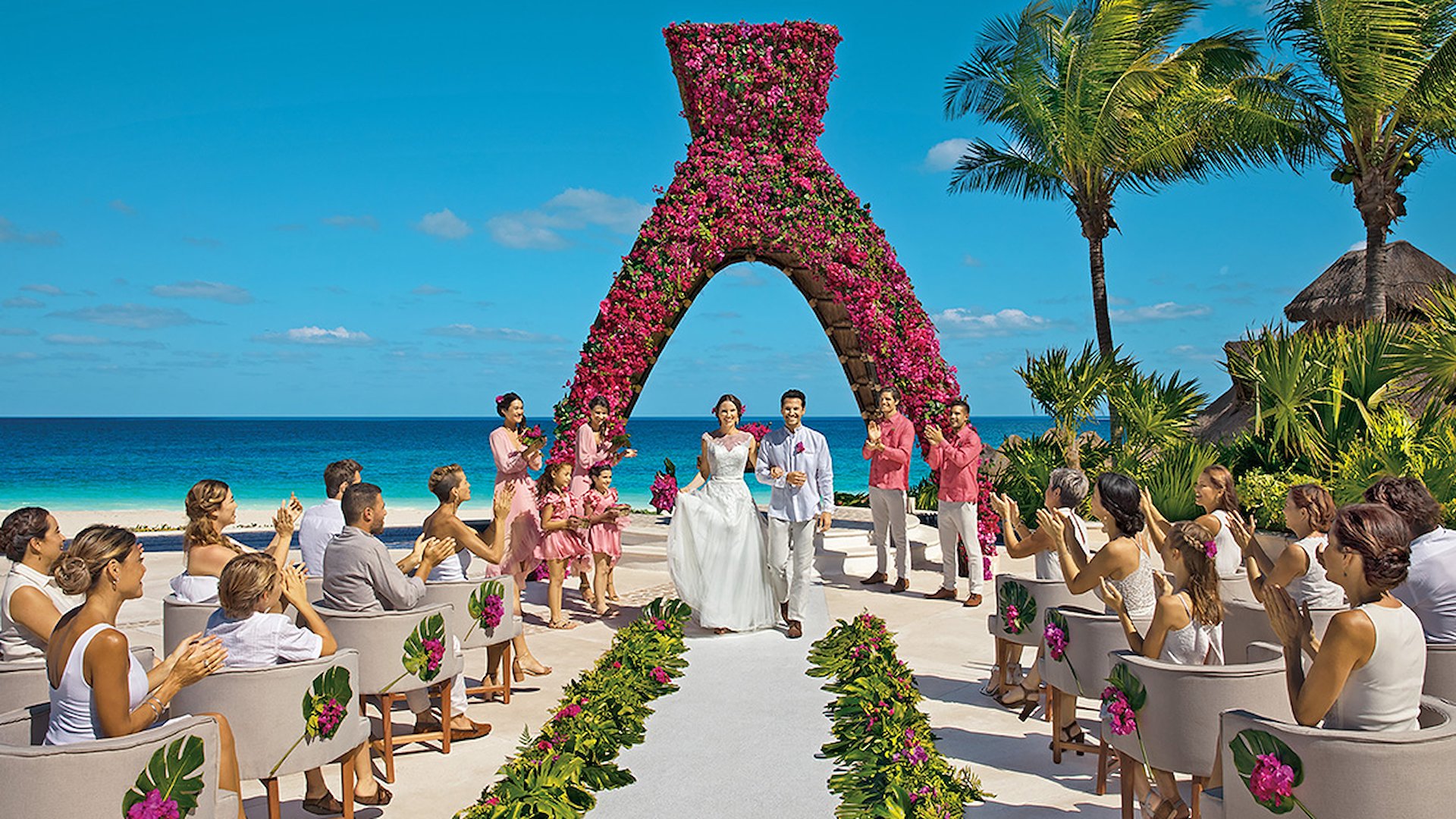
Mexico’s Caribbean coast (Cancun, Riviera Maya, Tulum) has the most demanding legal process in the broader region. Couples need to apostille their birth certificates and any divorce or death decrees, hire a Mexico-licensed perito traductor for Spanish translation, complete a local HIV and syphilis blood screening on arrival, satisfy 3 to 4 business days of pre-ceremony residency, and bring four witnesses. The total legal-only cost typically runs $700 to $2,000+.
The trade-off is the depth of resort-coordination experience. The Mexican Caribbean handles enormous volumes of foreign legal weddings every year, which means resort coordinators are unusually fluent in the process. For full destination-specific detail, see our Mexico legal hub, Cancun legal guide, Riviera Maya legal guide, and Tulum legal guide.
Same-Sex Marriage Across the Caribbean
Same-sex marriage law varies dramatically across the Caribbean. As of 2026:
Legal and performed:
-
- Mexico (legal nationwide since 2022, recognized in every state including the Mexican Caribbean)
-
- US Virgin Islands (US territory, US federal law applies)
-
- Curacao (Dutch territory)
-
- Cayman Islands (since 2019)
-
- British Virgin Islands (since 2022, under UK law)
Recognized from elsewhere but not performed locally:
-
- Aruba (Dutch territory; recognizes same-sex marriages from the Netherlands and other Hague-Convention countries)
-
- Bonaire (Dutch territory; similar recognition status)
Not legal locally:
-
- Jamaica
-
- Dominican Republic
-
- Bahamas
-
- Turks and Caicos
-
- Saint Lucia
-
- Barbados
-
- Antigua
LGBTQ+ couples wanting a legally binding Caribbean destination wedding most often choose Mexico, the US Virgin Islands, Curacao, the Cayman Islands, or the British Virgin Islands. Couples can still host beautiful symbolic ceremonies in any Caribbean destination, then handle the legal piece at home or at one of the destinations above.
Documents and Apostille Across the Region
The required-document list varies meaningfully by destination, but a few elements are common across the region:
-
- Valid passports are universally required.
-
- Certified birth certificates are required almost everywhere; some destinations require certificates showing the father’s name specifically.
-
- Divorce decree or death certificate required for previously married partners.
-
- Apostille requirements vary: Jamaica, Bahamas, Anguilla, Cayman Islands, Turks and Caicos, Barbados, and Antigua don’t require apostille. Mexican Caribbean, Dominican Republic, Saint Lucia, Curacao, and Aruba do.
-
- Translation requirements vary: Spanish-speaking destinations (Mexico, Dominican Republic) require certified translation through a local licensed translator. Dutch territories (Curacao, Aruba) may require translation depending on document type.
-
- Witnesses: most destinations require 2 witnesses; Mexico requires 4.
-
- Health screening: only the Mexican Caribbean requires a blood test (HIV and syphilis).
Legal-Only Costs Across the Caribbean
| Destination | Typical Legal-Only Cost (USD) | Driver |
|---|---|---|
| Jamaica | $100–$500 | License + officiant + RGD certificate |
| Bahamas | $200–$500 | License + officiant + certificate |
| Turks and Caicos | $200–$500 | License + officiant + certificate |
| Saint Lucia | $500–$1,200 | License + apostille + officiant + certificate |
| Dominican Republic | $500–$1,500 | Apostille + translation + judge + certificate |
| Mexican Caribbean | $700–$2,000+ | Apostille + translation + blood test + judge + certificate apostille |
Working with Caribbean Resorts on Legal Coordination
Across the Caribbean, the consistent good news is that resort wedding coordinators handle most of the legal-coordination work for foreign couples. Marriage license applications, officiant scheduling, document submission to local registries, translator coordination (where required), and post-ceremony certificate processing are typically all handled by the on-site wedding team at major all-inclusive resorts.
The biggest variable is coordination depth. Some destinations and properties have decades of foreign-wedding experience (the Mexican Caribbean and Jamaica lead by volume), while others handle fewer foreign weddings and require more couple-managed coordination. Your Certified Destination Wedding Specialist can match you to a resort with the right legal-coordination depth for your destination and timing.
What to Do When You Return Home
Caribbean civil marriages are recognized in the United States, Canada, the United Kingdom, and most other countries that participate in the Hague Convention. The post-ceremony process varies by destination:
-
- Jamaica and Bahamas: Request the official marriage certificate from the local Registrar General’s Department after the ceremony (6 to 8 weeks). Some home countries require apostille of the certificate before recognition.
-
- Mexico: Apostille the Mexican certificate through the relevant state’s Secretaría de Gobierno before you leave, then translate to English at home.
-
- Dominican Republic: Apostille the Dominican certificate before leaving, translate at home.
-
- US Virgin Islands: Marriage is automatically US-recognized; no additional steps needed.
For tax filings, name changes on passports and social security records, and immigration paperwork, your translated and apostilled certificate is the document of record. Keep multiple certified copies.

Caribbean Legal Wedding FAQs
What is the easiest Caribbean destination for a legal wedding?
Jamaica and the Bahamas are the easiest, with 24-hour residency, no apostille, no blood test, and inexpensive marriage licenses. Both destinations have direct flight access from most major US East Coast cities and deep resort-coordination experience. For couples wanting the simplest legally binding ceremony in the country, these two are the top choices.
Which Caribbean destinations allow same-sex marriage?
Same-sex marriage is legal and performed in Mexico (nationwide since 2022), the US Virgin Islands, Curacao, the Cayman Islands, and the British Virgin Islands. Aruba and Bonaire (Dutch territories) recognize same-sex marriages performed elsewhere. Jamaica, the Dominican Republic, the Bahamas, Turks and Caicos, Saint Lucia, Barbados, and Antigua do not currently allow same-sex marriages to be legally performed.
How long do we have to be in country before a Caribbean wedding?
Residency requirements vary widely. Jamaica and the Bahamas require 24 hours. Saint Lucia and Anguilla require 48 hours. The Mexican Caribbean requires 3 to 4 business days. The Dominican Republic, Turks and Caicos, Barbados, and Antigua have no residency requirement but may require advance document submission. Most couples plan to arrive at least 48 hours before the ceremony regardless of the residency rule.
Will our Caribbean marriage be recognized at home?
Yes, in nearly all cases. Caribbean civil marriages are recognized in the United States, Canada, the United Kingdom, and most other countries under the Hague Convention. Some home countries require the marriage certificate to be authenticated with an apostille before being recognized for legal purposes. Your destination’s apostille process varies; your Certified Destination Wedding Specialist can advise.
Should we get legally married in the Caribbean or do it at home?
Most Caribbean destination weddings are symbolic, with couples handling the legal piece at a courthouse back home. The symbolic-plus-legal-at-home path keeps planning streamlined, removes document and residency requirements, and lets couples focus entirely on the celebration. Couples who want one legally binding ceremony in the country often choose Jamaica or the Bahamas for the simplest process or Mexico for the deepest resort-coordination experience.
A Note on Verifying Current Requirements
Caribbean legal requirements change periodically, and individual destinations adjust fees, residency rules, and documentation expectations from time to time. Before booking, confirm current requirements with your resort’s wedding coordinator, your Certified Destination Wedding Specialist, or the US Embassy in your destination country.
Start Planning Your Caribbean Wedding
The right Caribbean destination for your legal wedding depends on three things: how much advance paperwork you’re willing to manage, how many pre-ceremony days in the country you can plan for, and whether the legal-ceremony piece even matters to you. For most couples, a symbolic ceremony in the destination plus a quick legal civil ceremony at home is the simplest path. For couples wanting one legally binding ceremony in country, Jamaica and the Bahamas are the easiest, and the Mexican Caribbean offers the deepest resort-coordination depth.
Our Certified Destination Wedding Specialists know every Caribbean destination’s legal process, every resort’s coordination depth, and every shortcut that smooths the planning. Fill out our online wedding planning form to get started.

About the Author

Maggie Sabin
Maggie started as the SEO Manager at DestinationWeddings.com in 2024, where she works to drive organic traffic and conversions while creating meaningful, SEO-optimized content for the website. Previously, Maggie's career spanned from Human Resources & Recruitment to teaching at international schools for almost 10 years. Maggie spends her free time traveling, learning new languages, reading non-fiction books, working out, going to the beach and spending time cuddling her dog, Lola!