
Most destination wedding planning arguments aren’t about the wedding. They’re about something the two of you never actually discussed, surfacing eight months later disguised as a disagreement about seating charts.
The good news is that the list of things worth settling in advance is short. Five conversations, none of which require a spreadsheet, and all of which are far easier to have now than during a tense phone call with a resort’s wedding office on hold.
Have them over a couple of evenings, before you look at a single venue. Our Certified Destination Wedding Specialists can tell within the first ten minutes of a call which couples have had these conversations and which haven’t.

1. What Are We Actually Doing This For?
Start with the least practical question, because everything else hangs off it.
Try to describe the day in one sentence each, without conferring. “A big party where everyone we know is in one room.” “A quiet dinner with fifteen people and really good food.” “A long weekend somewhere warm where nobody has to rush.” “Just us, somewhere beautiful, and a party later.”
These are genuinely different weddings with different budgets, different guest lists, and different destinations. Couples who haven’t compared their sentences usually find out during a venue tour, which is a poor moment to discover you wanted opposite things.
Name Two Things Each That Really Matter
Then go smaller. Each of you names one or two things you’d be disappointed to compromise on. The food. Live music. Being outdoors. Having everyone stay in the same place. Good photographs. Not being the centre of attention for eight hours.
This is more useful than a general conversation about taste, because it tells you where the money should go. Most destination weddings spread the budget evenly across everything and end up with a day that’s fine throughout and memorable nowhere. Knowing your partner’s two non-negotiables lets you protect those and be relaxed about the rest.
It also surfaces a specific and common mismatch: one person imagining a wedding and the other imagining a trip. Both are valid. They need different planning.
2. The Money, and Specifically Whose Money
You already know you need to agree on a number. What couples skip is the conversation underneath the number, which is where the friction actually lives.
What Does This Money Mean to Each of You?
People arrive at destination weddings with very different relationships to spending. One of you may see $20,000 on a single celebration as an obvious, joyful use of money. The other may find it genuinely uncomfortable regardless of whether it’s affordable.
Neither position is wrong, and neither shifts because the other person makes a good argument. What helps is naming it out loud so that every subsequent budget conversation isn’t secretly this conversation in disguise. If one of you flinches every time a number goes up, that flinch has a source, and it’s worth both of you knowing what it is.
Is Family Money a Gift or a Vote?
If parents are contributing, three things need establishing early: how much, when it’s actually available, and whether it comes with expectations.
Some families give money freely and genuinely don’t mind how it’s used. Others give it with an unspoken understanding that they’ll have a say in the guest list, the location, or the shape of the day. Neither is unreasonable. What causes damage is building a plan on money whose conditions you never established.
Ask directly: “Is this a gift, or would you want a say in how it’s used?” And agree between the two of you, before anyone asks, what your answer will be if the money comes with conditions you don’t want. It’s much easier to decide that in the abstract than in the moment.
What Are You Asking of Your Guests?
This one is specific to weddings that require travel, and it deserves its own moment.
A destination wedding shifts part of the cost from you to the people attending. At the all-inclusive resorts most of our couples choose, guests typically spend somewhere in the region of $1,800 to $2,500 each for around five nights including flights, with food and drinks covered.
These figures come from real spend data across the destination weddings our Certified Destination Wedding Specialists book each year.
Agree together how you feel about that, because you’ll be asked and you should have the same answer. Our DW Specialists are direct about the balance: keep guest costs in mind, but don’t book a venue that isn’t your dream just to keep the price down, because not everyone will make it regardless. Where the two of you land on that spectrum is a decision, and it’s better made deliberately than drifted into.

3. Who Is Actually Doing the Work?
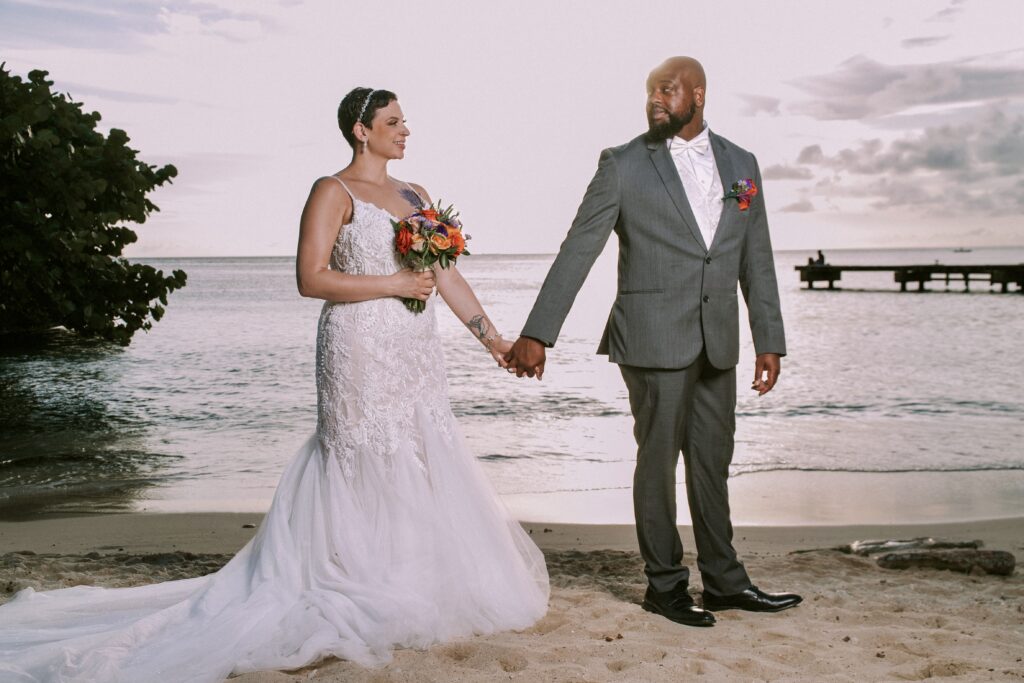
Wedding planning is a part-time job that lasts a year, and it very rarely splits evenly by accident.
What usually happens is that one person becomes the default planner. They hold every deadline, chase every supplier, and carry the mental load of remembering what hasn’t been done, while the other person is genuinely willing to help and waits to be asked. That arrangement breeds resentment quietly and reliably, and the resentment is rarely about the tasks. It’s about being the only one who remembers them.
Split by Area, Not by Task
The fix that works is dividing whole categories rather than individual jobs. One of you owns music and transport end to end. The other owns the guest list and communications. Owning something means remembering it exists, not waiting for a reminder.
Decide this now, while it’s theoretical, and neither of you is annoyed. And agree on what “owning” means: if it’s yours, you chase it, you make the decision, and the other person trusts you.
Decide What You’re Not Doing Yourselves
When we ask our Certified Destination Wedding Specialists what the biggest mistake couples make is, the answer at the top of the list is attempting to handle the entire planning process themselves.
Worth deciding early, together, what you’re outsourcing. A travel specialist handling the group booking. A resort’s on-site coordinator handling the day. An external planner if you want someone working solely for you. The couples who struggle most are usually the ones who quietly assumed they’d manage everything and then felt they couldn’t admit halfway through that it was too much.
4. Where the Line With Family Is
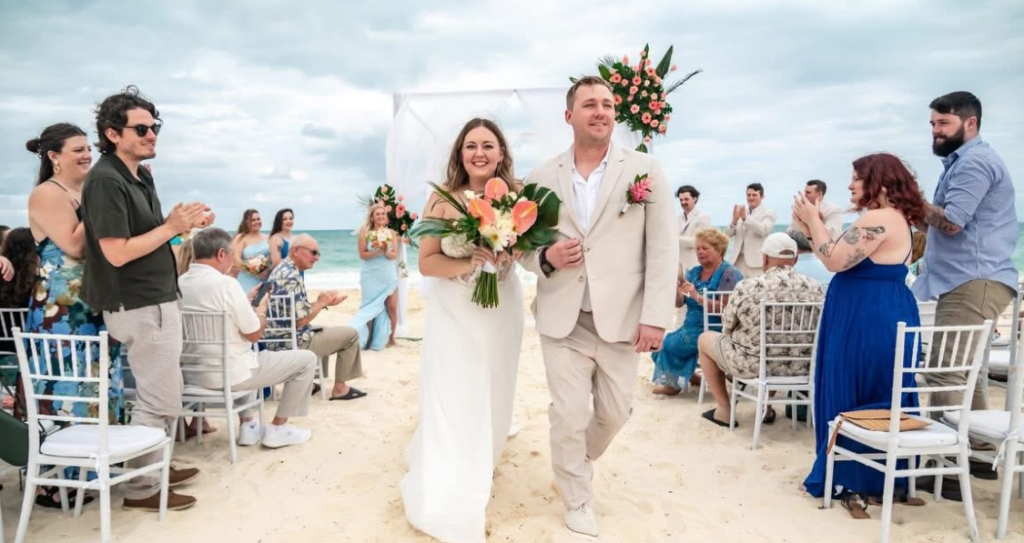
Every couple has at least one family member with strong opinions. The question isn’t how to stop them having opinions. It’s what you’ll do when they express them.
Agree on one rule, and it solves most of it: each of you handles your own family. You take your mother’s phone calls about the guest list. Your partner takes theirs. Nobody has to be the one delivering unwelcome news to in-laws, which is the arrangement that damages relationships fastest.
Agree also on what’s actually open for discussion. Some things genuinely aren’t, and it’s kinder to be clear about that early than to appear to consider every suggestion and then decline them all. Our Certified Destination Wedding Specialists put the wider principle simply: take outside opinions with a grain of salt, and choose the wedding you love rather than the one your guests might prefer.
That said, one piece of family advice from the same source is worth taking seriously in the other direction. Getting close family on board early is one of the most reliable ways to keep a planning year calm. Having a boundary and bringing people in aren’t opposites. They work best together.
5. What Happens When You Disagree?
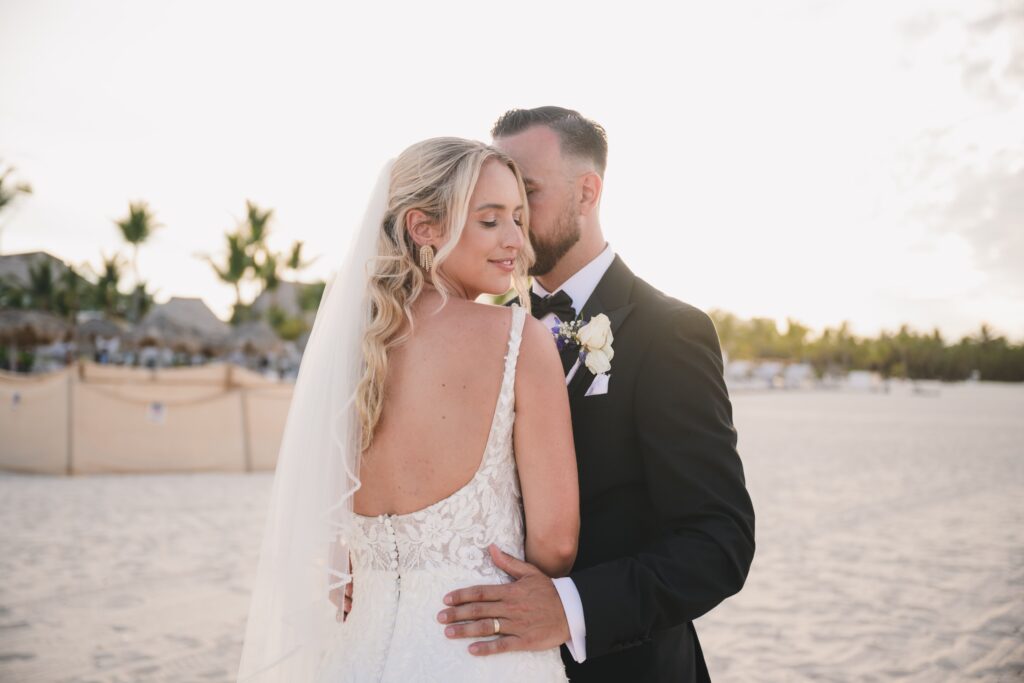
You will. Probably about something small, at a moment when you’re both tired, and a deposit is due.
Decide the rule now, while it’s abstract. A few that work well:
- Whoever cares more, wins. Say a number out of ten for how much it matters to you. The higher number takes it. Surprisingly effective, and it stops people arguing hard about things they’re mildly interested in.
- Whoever owns the area decides. If you split by category, the owner has final say. That’s what ownership means.
- Nothing gets decided after 10pm. Almost every wedding argument is worse at night and smaller in the morning.
- One veto each. Each of you gets one absolute no across the whole process, used without needing to justify it.
The specific rule matters less than having agreed on one. What turns a small disagreement into a bad evening is not the disagreement. It’s having no way to end it.
How These Five Fit Together
They’re deliberately in order, and the order does real work.
| Conversation | What it decides | What it prevents |
|---|---|---|
| The vision | The kind of wedding it is | Discovering a mismatch on a venue tour |
| The money | The budget and its conditions | Family contributions with hidden strings |
| The workload | Who owns what | One person carrying the whole year |
| The families | Who handles whom | Lasting friction with in-laws |
| The disagreements | How things get settled | Small arguments becoming big ones |
Only after all five does it make sense to choose a place and a date. Budget, then headcount, then the kind of day, then the wedding destination that fits all three. The date comes last, not first, which is the reverse of how most people do it.

Conversations to Have With Your Fiancé FAQs
What should you talk about with your fiancé before wedding planning?
Five things: what kind of day you each imagine, the total budget and whether family money comes with expectations, how the planning work will be divided, how you’ll handle family opinions, and how you’ll settle disagreements. All five are easier to discuss before any money is committed and any date is public.
How do you split wedding planning fairly?
Divide by whole areas rather than individual tasks. One person owns music and transport completely; the other owns the guest list and communications. Owning an area means remembering it and making the call, not waiting to be asked. Splitting task by task is what creates a default planner who carries the mental load alone.
What if you and your fiancé want different weddings?
It’s very common and usually resolvable, because the difference is often about scale rather than taste. Have each of you name the two things you’d genuinely be disappointed to lose, then build around protecting those four things. A blended answer that protects both people’s priorities usually beats a compromise that gives neither of you what you wanted.
How do you handle family opinions about the wedding?
Agree that each of you handles your own family, so neither of you is delivering unwelcome news to in-laws. Be clear early about what’s genuinely open for discussion and what isn’t. Bringing close family in early tends to reduce friction considerably, which is different from putting decisions to a vote.
Should you agree a budget before choosing a venue?
Yes, always. A wedding venue chosen before the budget is agreed becomes a fixed point that every later problem has to bend around, and the usual solutions are cutting guests or finding more money. Settle the budget, then the rough guest count, then the kind of celebration, and choose a place that fits all three.
Have the Conversations, Then Have the Fun
A couple of evenings of slightly awkward talking buys you a year of much easier decisions. It’s a genuinely good trade, and the conversations are far more interesting than they sound once you’re in them.
When you’ve got your answers and you’re ready to see what they actually buy, we’ll put real numbers against them. Fill out our online wedding planning form and one of our Certified Destination Wedding Specialists will show you what’s possible!

About the Author

Maggie Sabin
Maggie started as the SEO Manager at DestinationWeddings.com in 2024, where she works to drive organic traffic and conversions while creating meaningful, SEO-optimized content for the website. Previously, Maggie's career spanned from Human Resources & Recruitment to teaching at international schools for almost 10 years. Maggie spends her free time traveling, learning new languages, reading non-fiction books, working out, going to the beach and spending time cuddling her dog, Lola!