
Getting legally married in Mexico isn’t complicated, but the steps are specific. You’ll need a civil ceremony at a Mexican Registry Office (Registro Civil), three to four business days in the country before the ceremony, apostilled and translated documents, and a brief health screening completed locally.
The good news: most all-inclusive resort wedding teams have walked thousands of couples through this exact process, and our Certified Destination Wedding Specialists coordinate the paperwork on your behalf.
Here’s what every couple should know before booking a legal Mexico wedding, with the exact documents, fees, and steps spelled out.

Civil vs. Symbolic Ceremony in Mexico: At a Glance
| Civil Ceremony | Symbolic Ceremony | |
|---|---|---|
| Legally binding? | Yes (internationally recognized) | No (marry legally at home before or after) |
| Documents required | Passports, apostilled birth certificates (translated), tourist permit (FMM), divorce/death decrees if applicable, four witnesses’ ID copies | Passport only |
| Days in Mexico before ceremony | 3–4 business days minimum | None (any travel timing works) |
| Health screening | Required (HIV, syphilis); done in Mexico, valid 14 days | None |
| Typical legal-only cost | $700–$2,000+ (varies by state and resort) | Included in most resort wedding packages |
| Best for | Couples who want one ceremony, legally recognized in Mexico and back home | Couples handling the legal side at home want a stress-free destination celebration |
Your Ceremony Options in Mexico
There are three ways to say “I do” in Mexico. Only one is legally binding, but all three can stand alone as the celebration itself.
Civil Ceremony (Legally Binding)
A civil ceremony, performed by a Juez del Registro Civil (Civil Registry Judge), is the only marriage type recognized as legally binding under Mexican law. Once the judge has signed your marriage certificate (acta de matrimonio), your marriage is automatically recognized internationally, including back in the United States. You’ll need four witnesses (each with a valid government-issued ID), apostilled and translated documents, and a brief health screening completed in Mexico.
Symbolic Ceremony (Most Popular)
The vast majority of Mexico destination weddings are symbolic. A symbolic ceremony exchanges vows, rings, and emotion without the paperwork. It’s not legally binding, but couples who want a legal marriage simply handle that piece quietly at a courthouse back home before or after the trip. Symbolic ceremonies need no advance documents, no health tests, and no residency requirement, which is why most all-inclusive wedding packages default to this option.
Religious Ceremony
Some couples add a religious ceremony, conducted by a priest, rabbi, minister, or other officiant. Religious ceremonies are not legally binding in Mexico unless paired with a civil ceremony. Several resorts have on-site chapels and on-call religious officiants; others can connect you with a local clergy member. Lead times are longer for religious ceremonies, so start the conversation with your Specialist at least nine months out.
Should You Marry Legally in Mexico, or at Home?
Most couples we work with do the legal paperwork at home and hold a symbolic ceremony in Mexico. That isn’t a compromise, and it’s worth understanding why it’s the default before you assume the civil route is the “real” one.
A legal ceremony in Mexico means apostilling documents four to eight weeks before you fly, paying for certified Spanish translation, arriving three to four business days early, sitting for blood work in-country, and then apostilling the Mexican certificate again once you’re home to make it usable. It’s entirely doable, and our Certified Destination Wedding Specialists coordinate all of it. It’s also roughly two months of admin and $700 to $2,000 on top of your wedding package.
A courthouse appointment at home the week before you travel takes about twenty minutes and costs under $100 in most states. Your ceremony in Mexico is then identical in every way that your guests will experience: same venue, same vows, same photographs, same officiant walking you through it.
Choose the legal ceremony in Mexico if you want one single ceremony that is legally binding, the documentation matters to you symbolically, or you’re combining it with a residency or immigration process.
Choose symbolic in Mexico, legal at home if you’re on a tight timeline, your document history is complicated (a recent divorce, a name change, a foreign-issued birth certificate), or you’d simply rather spend those three extra days on the beach than at a registry office.
There’s no wrong answer, and nobody at your wedding will be able to tell which one you picked.

Required Documents for a Legal Mexico Wedding

Mexico’s document requirements are detailed but consistent. Most documents need to be gathered well before you travel, with an apostille and Spanish translation completed in your home country. Plan for 4 to 8 weeks of prep before your departure date.
- Valid passports for both partners (minimum six months remaining validity).
- Original birth certificates, both partners, apostilled in your home country and translated into Spanish by an official perito traductor (more on that below). Three certified copies of each are typical.
- Tourist permit (FMM), issued automatically when you fly into Mexico. Carry the printed receipt.
- Single status affidavit or sworn statement of singleness, apostilled and translated. Some states require this; your Specialist will confirm.
- Divorce decree or death certificate of a previous spouse, if applicable, apostilled and translated. Divorces must be finalized at least one year before remarriage in some states.
- Four witnesses, each with a valid passport or government-issued photo ID. Witnesses must be at least 18 years old. Your wedding party or resort staff can serve in this role.
- Health certificate issued by a Mexican physician (see Health Screening section below).
What an Apostille Actually Is
An apostille is an international certification issued under the 1961 Hague Convention. It’s how Mexico verifies that documents issued in your home country are authentic. For US documents, the apostille is issued by the Secretary of State in the state where the document was originally issued (your birth certificate’s state, your divorce decree’s state, etc.). Allow two to four weeks for apostille processing. Federal documents (Naturalization Certificates, FBI background checks) are apostilled through the US Department of State.
Perito Traductor: The Required Spanish Translator
All foreign documents must be translated into Spanish by a perito traductor, an official translator authorized by the Mexican court system in the state where you’re marrying. Translations done outside Mexico (or by a non-certified translator) will not be accepted. Most resort wedding teams coordinate this directly through a local perito traductor and bundle the cost into the legal wedding package. Expect to pay $50–$150 per document for certified translation.
Health Screening Requirements
Mexican states require a basic health screening before a marriage license is issued. The standard tests are an HIV antibody screen and a syphilis (RPR) test, with chest X-rays and blood-type tests occasionally requested in specific states. The screening must be done in Mexico (results from outside the country are not accepted) at a state-approved lab or clinic, and the certificate is valid for 14 days.
Costs run roughly $100 to $300 per person, with a 24- to 48-hour turnaround. Your resort wedding team will direct you to the local approved provider; some all-inclusive packages bundle the cost.
How Long You Need to Be in Mexico
For a legal civil ceremony, plan to arrive in Mexico at least three to four business days before your wedding date. That window covers your health screening, document submission to the Registro Civil, and the standard 48-hour waiting period some states observe. If your wedding falls on or near a Mexican holiday, give yourself an extra day or two of cushion because Registry Offices close on national holidays.
The Legal Wedding Process, Step by Step
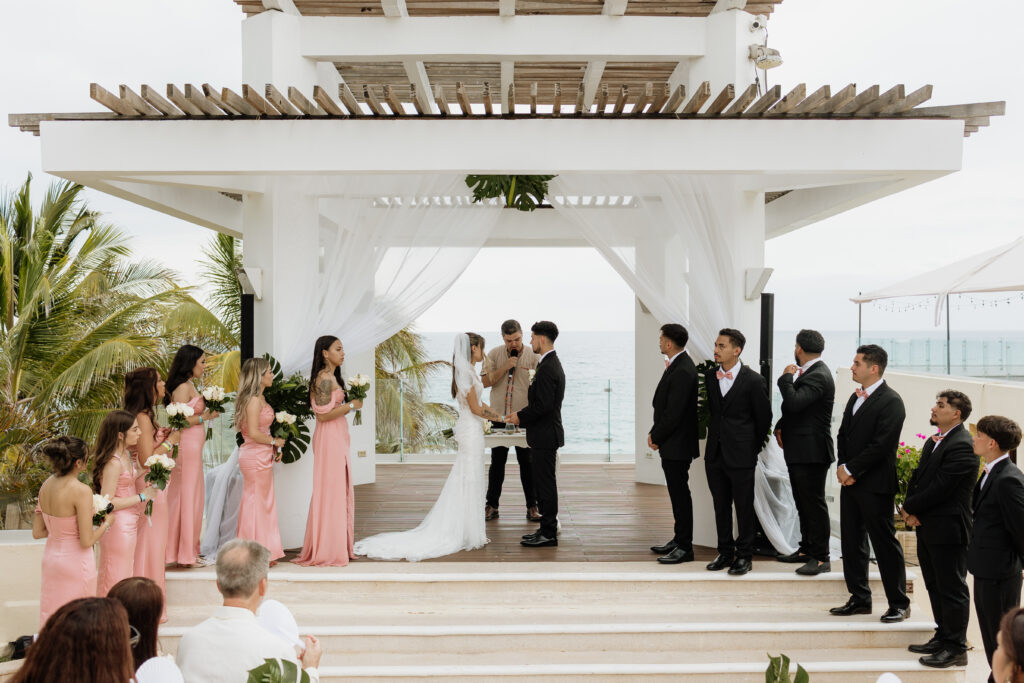
Here’s the path from “engaged” to “legally married in Mexico,” in order.
Step 1: Gather and Apostille Your Documents (Home Country)
4 to 8 weeks before travel, request fresh certified copies of birth certificates and any divorce or death certificates, then apostille each through your Secretary of State. Send originals to your resort wedding coordinator or Certified Destination Wedding Specialist for Spanish translation through a perito traductor.
Step 2: Arrive in Mexico and Complete Health Screening
On your first or second day in the country, visit the state-approved lab for blood work. Results are typically issued within 24 to 48 hours and are valid for 14 days.
Step 3: Submit Marriage Application to the Registro Civil
Your resort coordinator or wedding planner submits the marriage application, your apostilled and translated documents, and your health certificate to the local Civil Registry Office. The registry office reviews and approves, typically within 24 to 48 hours.
Step 4: The Civil Ceremony
A Juez del Registro Civil performs the ceremony either at the registry office itself or, for an additional fee, at your resort, beach, or off-site venue. Four witnesses sign the marriage certificate alongside you and your partner. The ceremony itself runs about 20 to 30 minutes and is conducted in Spanish; many couples arrange for an English interpreter.
Step 5: Apostille Your Mexican Marriage Certificate
Your acta de matrimonio is issued in Spanish. To make it valid in your home country, you’ll need to apostille the Mexican certificate through the relevant Mexican state’s Secretariat (Secretaría de Gobierno), then have it translated back into English upon return. Your Specialist or resort coordinator can walk you through the timing; this step typically happens after you’ve left Mexico.
Same-Sex Marriage in Mexico

Same-sex marriage is legal nationwide in Mexico as of 2022. All 32 Mexican states recognize same-sex civil marriages, with identical legal procedures, documents, and protections as opposite-sex marriages. LGBTQ+ couples have the same right to civil ceremonies, marriage certificates, and international recognition. Resorts and Civil Registry Offices across Mexico’s wedding hubs (Cancun, Riviera Maya, Tulum, Los Cabos, Puerto Vallarta) have full experience hosting same-sex civil ceremonies.
Mexico Legal Wedding Costs
Here’s a breakdown of what the legal piece itself typically costs, separate from the resort wedding package, dining, decor, and travel.
| Item | Typical Cost (USD) | Notes |
|---|---|---|
| Apostille (per document, home country) | $20–$50 | Issued by your state Secretary of State |
| Certified Spanish translation (per document) | $50–$150 | Must be a Mexico-licensed perito traductor |
| Health screening (per person) | $100–$300 | Done in Mexico, results in 24–48 hours |
| Civil ceremony at registry office | $30–$120 | ~500–2,000 pesos, varies by state |
| Off-site civil ceremony (resort, beach) | $90–$300 | ~1,500–5,000 pesos plus judge’s travel fee |
| Resort legal wedding package (bundled) | $500–$1,500 | Includes coordinator, judge fee, translator, and witnesses if needed |
| Total legal-only cost | $700–$2,000+ | Separate from resort package, dining, and decor |
*For the broader cost picture (resort packages, airfare, accommodations, dining), see our Cancun cost guide or destination-specific cost guides for Riviera Maya, Tulum, Los Cabos, and Puerto Vallarta.
RELATED: How to Get Married in Mexico on a Budget
Destination-Specific Legal Wedding Guides
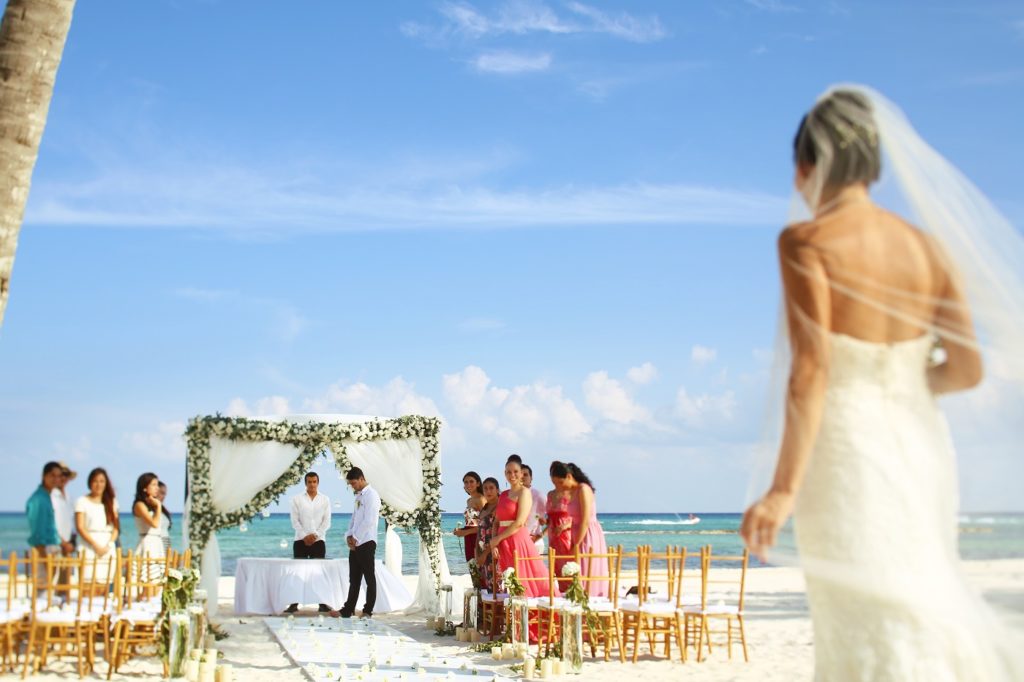
Each Mexican state has its own Civil Registry Office, its own fee schedule, and its own specific quirks for foreign couples. For step-by-step details by destination, see our local legal guides:
- How to Legally Get Married in Riviera Maya
- How to Legally Get Married in Tulum
- Getting Married in Cancun: What You Need to Know
- Getting Married in Cabo: Everything You Need to Know
- How to Get Married in Puerto Vallarta

Mexico Legal Wedding FAQs
How long do we need to be in Mexico for a legal wedding?
Plan to arrive at least three to four business days before your wedding date. That window covers your health screening (which must be done in Mexico, 24 to 48 hours for results), document submission to the Registro Civil, and the 48-hour waiting period some states observe. Add an extra day if your trip falls on or near a Mexican holiday.
Is same-sex marriage legal in Mexico?
Yes. Same-sex marriage is legal nationwide in Mexico as of 2022. All 32 states recognize same-sex civil marriages with the same procedures, documents, and protections as opposite-sex marriages. LGBTQ+ couples have full access to legal civil ceremonies in every Mexican wedding hub.
Will our Mexican marriage be recognized back home?
Yes, as long as your civil ceremony was performed by a Juez del Registro Civil and your marriage certificate (acta de matrimonio) is properly issued and apostilled. Mexican civil marriages are recognized in the United States, Canada, the UK, and most other countries under the Hague Convention. Once home, file your apostilled and translated certificate with your local government office to record the marriage.
Do we really need blood tests to marry in Mexico?
Yes, for a civil ceremony. Mexican states require a basic health screening (HIV antibody and syphilis tests; occasionally chest X-rays or blood type). The screening must be done at a Mexico-approved lab within 14 days of the ceremony. Results are typically issued in 24 to 48 hours and cost about $100 to $300 per person. Symbolic ceremonies don’t require any health screening.
What is an apostille and where do I get one?
An apostille is an international certification under the 1961 Hague Convention that authenticates public documents for use in another country. For US documents, the apostille is issued by the Secretary of State in the state where each document was originally issued (your birth state for your birth certificate, your divorce state for divorce decrees). Federal documents are apostilled through the US Department of State. Allow two to four weeks for processing.
A Note on Verifying Current Requirements
Legal requirements can change, and individual states adjust fees and document requirements periodically. Before booking, confirm current requirements with the Mexican consulate nearest you (or the US Embassy in Mexico) and with your resort’s wedding coordinator. Your Certified Destination Wedding Specialist will stay current on state-by-state requirements through the planning process.
Plan Your Legal Mexico Wedding with Confidence
A legal Mexico wedding is more paperwork than a symbolic one, but it’s also entirely doable with the right team behind the scenes. Most couples find that the time spent gathering apostilled documents in the months before the trip is worth it for the simplicity of having one legally recognized ceremony in the destination they love.
Our Certified Destination Wedding Specialists coordinate the legal piece (documents, translation, judge scheduling, witnesses) so you can focus on the celebration. Fill out our wedding planning form to get started.


About the Author

Maggie Sabin
Maggie started as the SEO Manager at DestinationWeddings.com in 2024, where she works to drive organic traffic and conversions while creating meaningful, SEO-optimized content for the website. Previously, Maggie's career spanned from Human Resources & Recruitment to teaching at international schools for almost 10 years. Maggie spends her free time traveling, learning new languages, reading non-fiction books, working out, going to the beach and spending time cuddling her dog, Lola!