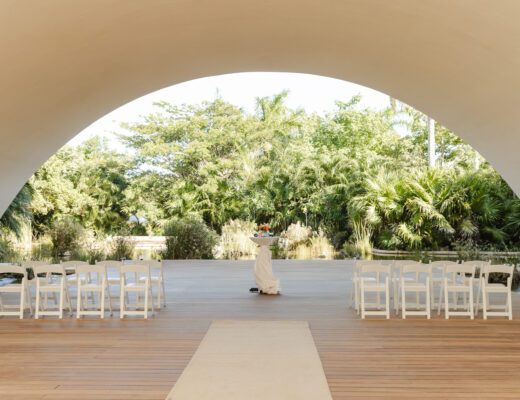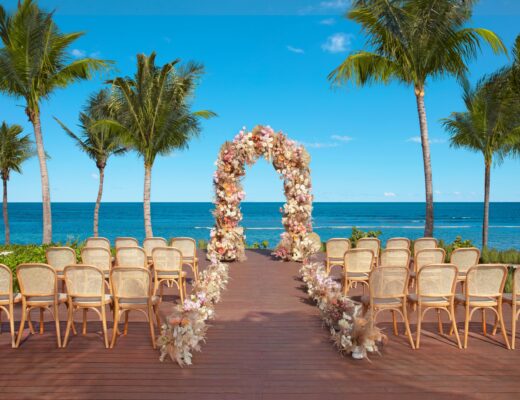
Somewhere around the second margarita, your guests are wandering between the swim-up bar and the buffet, and not a single one of them has reached for a wallet all afternoon. That’s the all inclusive destination wedding promise! Your ceremony, reception, meals, drinks, activities, and entertainment are bundled into one nightly rate so everyone shows up, settles in, and just enjoys the celebration.
The alternative, a non-all inclusive (European Plan) destination wedding, takes a different path. Your accommodations are covered, but meals and drinks are à la carte. It’s the format used by most U.S. and European hotels, by certain Caribbean boutiques, and by luxury properties like Four Seasons, Ritz-Carlton, and Rosewood that prefer to charge for their high-end dining experiences individually.
Based on real data from couples we’ve helped plan, the average destination wedding costs $9,850 at an all inclusive resort, compared to $36,000 for a traditional U.S. wedding (per Zola’s 2026 Wedding Spend Survey). The all inclusive format is the structural reason behind most of those savings, but it isn’t the right pick for every couple.
Most couples we’ve helped plan ultimately choose all inclusive for the budget predictability and the guest convenience, but European Plan can be the right call for smaller weddings, foodie couples who want flexibility on dining, or destinations where the resort scene leans EP (parts of Costa Rica, certain Caribbean islands). The path you pick shapes everything that follows: your total budget, your guests’ costs, the planning workload, and the feel of the celebration itself.
Here’s what to know before you choose. Our Certified Destination Wedding Specialists can help you compare and plan.
What Is an All Inclusive Destination Wedding?
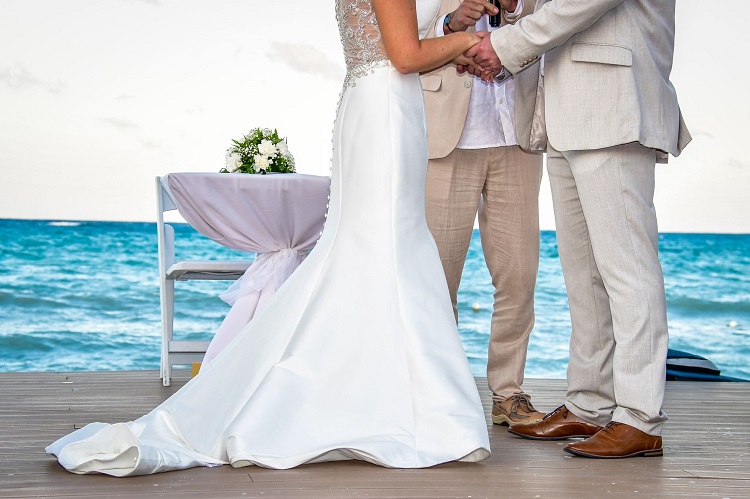
An all inclusive destination wedding takes place at a resort where one nightly rate covers your room, every meal, every drink (often premium liquor), most activities, and the entertainment that fills the days around the wedding. Your wedding package layers on top of that, with the ceremony venue, decor, cake, sparkling wine toast, coordinator, and often a private reception bundled into one fixed price.
For your guests, the math is simple. Once they book the resort, they’re done thinking about money. They’re not pulling out a credit card every time they sit down at a restaurant or order a piña colada at the swim-up bar. For you, the math is also simple: most of your wedding costs are wrapped into one package agreement with the resort, replacing the 10 to 15 separate vendor contracts you’d manage at a traditional wedding.
The most popular destination wedding regions for all inclusive resorts are Mexico (Cancun, Riviera Maya, Cabo, Puerto Vallarta), the Dominican Republic (Punta Cana, Cap Cana), and Jamaica (Montego Bay, Negril, Ocho Rios). Top resort brands like Hyatt Ziva, Dreams, Secrets, Hard Rock, Sandals, Couples, Royalton, and Riu lead the all inclusive wedding scene.
What Is a Non-All Inclusive (European Plan) Destination Wedding?
A non-all inclusive destination wedding, also called a European Plan (EP) wedding, takes place at a resort or hotel where your nightly rate covers your room and not much else. Meals, drinks, and most activities are charged separately at the resort’s restaurants or off-property. Guests pay as they go.
European Plan is the standard format for most U.S. and European hotels, and it’s common in destinations like the U.S. Virgin Islands, parts of Costa Rica, and certain Caribbean boutique islands. Luxury properties like Four Seasons and Ritz-Carlton typically operate on EP because they prefer to charge à la carte for their high-end dining experiences rather than bundle everything into the room rate.
For weddings, EP gives you more flexibility on dining and off-property exploration, but it also means your guests budget separately for every meal, every drink, every excursion. Cost predictability is harder, and the wedding budget itself often runs higher because catering, bar, and reception services aren’t bundled into the resort rate.
Side-by-Side Comparison: All Inclusive vs. Non-All Inclusive
| Factor | All Inclusive | Non-All Inclusive (EP) |
| Cost predictability | High (one rate covers most things) | Lower (à la carte adds up) |
| Guest convenience | Maximum (no wallet needed on-site) | More effort (pay as you go) |
| Wedding package structure | Bundled (ceremony, decor, cake, reception in one) | Mostly à la carte |
| Off-property dining flexibility | Possible but pays-twice | Built into the format |
| Typical total cost (couple) | $9,850 average | $12,000 to $25,000+ depending on resort |
| Best for | Predictable budgets, larger groups, varied guest preferences | Smaller weddings, foodies, luxury-resort couples, EP-only destinations |
Pros and Cons of an All Inclusive Destination Wedding
Pros:
- One nightly rate covers meals, drinks, and most activities for guests.
- Wedding packages bundle ceremony, decor, cake, and reception into one fixed price.
- Many all inclusive resorts offer complimentary or deposit-only packages with qualifying room blocks.
- Guests don’t need to budget separately for meals or pull out wallets at the resort.
- Total wedding budget is far easier to forecast and stick to.
Cons:
- Less flexibility for couples who want to host meals at off-property restaurants.
- Some resorts have multiple weddings per day, which can feel less exclusive.
- Premium dining or specialty stations often carry per-person upgrade fees.
Pros and Cons of a Non-All Inclusive Destination Wedding
Pros:
- Maximum flexibility on dining and off-property excursions.
- Boutique and luxury properties often offer more personalized service and exclusivity.
- Custom catering and bar packages can be tailored to your exact taste.
- Better fit for smaller weddings (under 20 guests) where bundled inclusions don’t deliver scale value.
Cons:
- Guests budget separately for every meal, drink, and activity, which adds up fast.
- Higher per-person catering and bar costs compared to bundled packages.
- More vendor coordination required, often more like a traditional wedding workload.
- Less common at the most affordable destinations (Mexico, DR, Jamaica), where all inclusive dominates.

From Our Certified Destination Wedding Specialists: When Each Format Wins
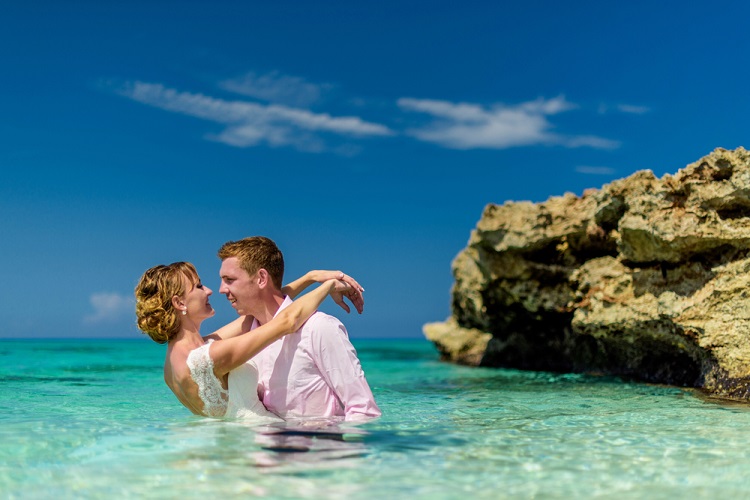
When asked where couples get the biggest bang for their wedding buck, our Certified Destination Wedding Specialists consistently point to all inclusive resorts in Mexico‘s Cancun and Riviera Maya regions: “Many resorts to choose from, and Cancun flights are often the most affordable.” For couples on a tight budget, they most often recommend Sandos Cancun and Planet Hollywood Adult Scene Cancun by Royalton, both of which operate on the all-inclusive model.
For couples drawn to a smaller, more boutique celebration, or to a luxury property where à la carte dining is part of the magic, European Plan can be the right call. Our Wedding Specialists also flag that some Costa Rica properties and certain U.S. Virgin Islands resorts only operate on EP, so the choice is partly determined by where you want to get married.
When a Non-All Inclusive Wedding Makes Sense
A non-all inclusive resort & venue can be the better fit when:
- Your guest list is small (under 20), so bundled inclusions don’t generate enough scale value.
- You want a boutique or luxury property (Ritz-Carlton, Four Seasons, smaller Belize jungle lodges) that doesn’t operate on the all inclusive model.
- You’re getting married in a destination where European Plan is the standard (parts of Costa Rica, certain Caribbean islands).
- You and your guests genuinely want to explore off-property dining and prefer flexibility over predictability.
- You’re planning a custom-catered reception with very specific menu requirements that bundled packages can’t accommodate.
How to Decide What’s Right for Your Wedding
A few quick questions to point you toward the right format:
- Budget priority? → All Inclusive almost always wins.
- Guest count over 25? → All Inclusive scales better.
- Want maximum flexibility on dining? → European Plan.
- Set on a specific luxury property like Four Seasons or Rosewood? → Likely European Plan.
- Mexico, DR, or Jamaica? → All Inclusive dominates these markets.
- Costa Rica or U.S. Virgin Islands? → European Plan is more common.
Most couples we’ve helped plan ultimately choose all inclusive destination weddings, especially in the under-$15,000 budget range, because the structural advantages compound: bundled costs, predictable totals, easier guest experience, and access to complimentary wedding packages tied to room block thresholds.

All Inclusive vs. Non-All Inclusive Destination Wedding FAQs
What’s the difference between an all inclusive and a non-all inclusive destination wedding?
An all inclusive destination wedding takes place at a resort where one nightly rate covers meals, drinks, activities, and entertainment for you and your guests. A non-all inclusive (European Plan) destination wedding covers accommodations only, and guests pay separately for every meal and drink. Most destination wedding couples choose all inclusive for budget predictability and an easier guest experience.
Are all inclusive destination weddings cheaper than non-all inclusive weddings?
Yes, in most cases. Based on real data from our couples, the average all inclusive destination wedding costs $9,850, while non-all inclusive destination weddings typically run $12,000 to $25,000 or more, depending on the resort and dining choices. The bundled package format eliminates per-person catering and bar charges that drive non-all inclusive costs higher.
Which destinations offer all inclusive wedding packages?
Mexico (Cancun, Riviera Maya, Cabo, Puerto Vallarta), the Dominican Republic (Punta Cana, Cap Cana), and Jamaica (Montego Bay, Negril, Ocho Rios) have the largest all inclusive wedding markets. Most major Caribbean islands (Antigua, St. Lucia, Bahamas, Aruba) also have strong all inclusive options. Costa Rica and the U.S. Virgin Islands venues lean European Plan.
Can I have a non-all inclusive wedding at an all inclusive resort?
Generally no. All inclusive resorts charge their nightly rate as a flat fee that includes all meals and drinks, and you can’t typically opt out of the inclusive portion. If you want à la carte dining flexibility, look at boutique European Plan properties or luxury resorts (Four Seasons, Ritz-Carlton) that operate on EP rather than the all inclusive model.
What’s included in an all inclusive wedding package?
A standard all inclusive wedding package typically includes the ceremony venue, an officiant, basic decor, a small cake, a sparkling wine toast, a bouquet and boutonniere for the couple, and an on-site coordinator. Mid- and high-tier packages add private receptions, professional photography, live music or a DJ, upgraded floral, and honeymoon perks. The “all inclusive” portion of the resort stay (meals, drinks, activities) is separate from the wedding package itself.
Plan Your Destination Wedding Today
Whether you’re picturing a barefoot beach ceremony with everything covered or a candlelit chef’s tasting menu at a quiet boutique property, the wedding you imagine is closer than you think. Our Certified Destination Wedding Specialists know which resorts and which formats fit which kind of celebration, and our planning services are completely free to the couple. No fees, no fine print.
Fill out our online wedding planning form to start the conversation. Let’s plan a wedding that feels like the most extraordinary version of yourselves.

About the Author

Maggie Sabin
Maggie started as the SEO Manager at DestinationWeddings.com in 2024, where she works to drive organic traffic and conversions while creating meaningful, SEO-optimized content for the website. Previously, Maggie's career spanned from Human Resources & Recruitment to teaching at international schools for almost 10 years. Maggie spends her free time traveling, learning new languages, reading non-fiction books, working out, going to the beach and spending time cuddling her dog, Lola!